
Choosing a finish
How to Choose a Wall Finish for an Orange County Home
Seven hand-applied finishes, one room at a time. A practical way to narrow the field by mood, light, traffic, and how the wall actually gets used - so the finish reads right in your room, not just in a photo.
11 min read
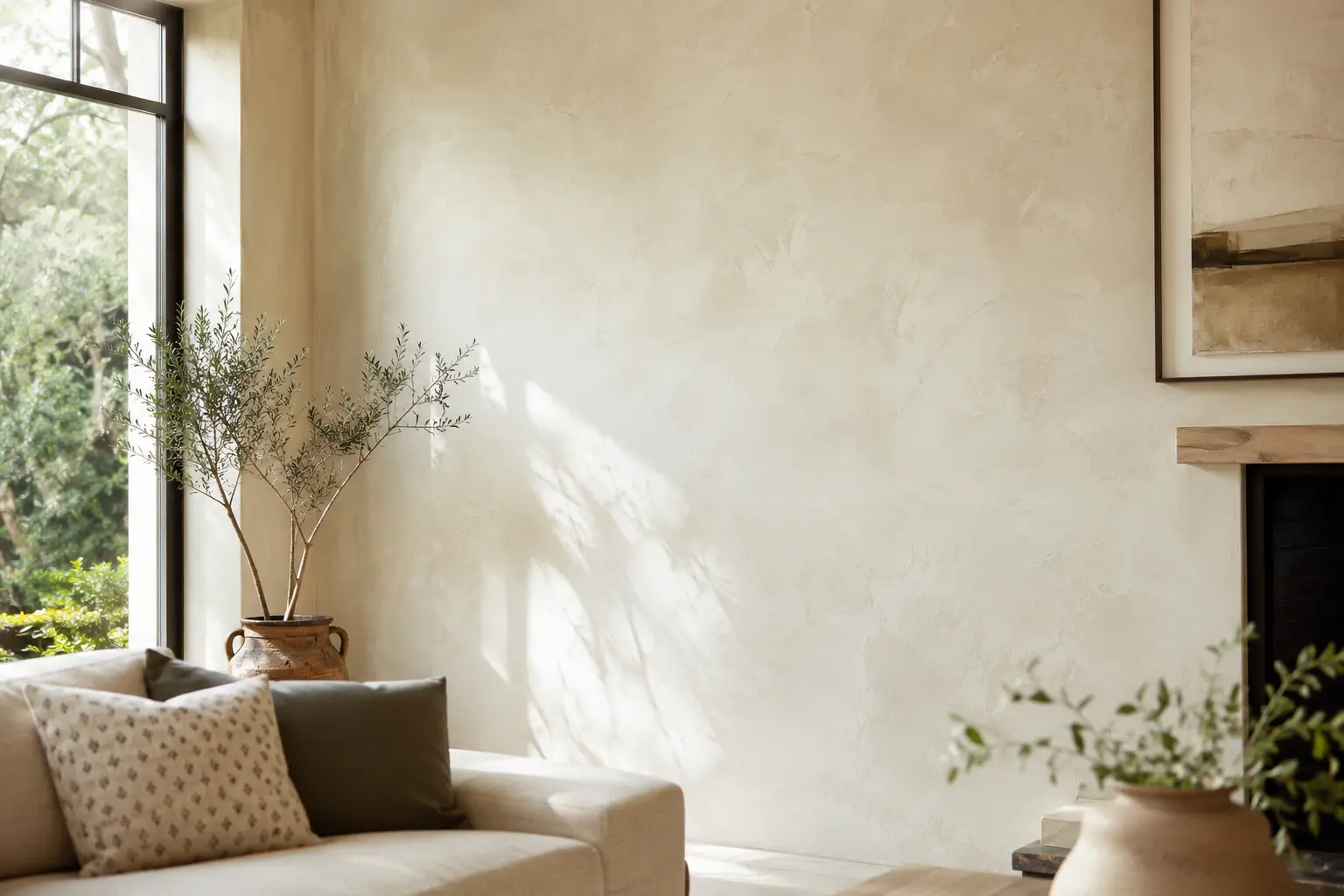
A wall finish sets the mood of a room before anything else is in it. Before the furniture arrives, before the art goes up, before a single lamp is switched on, the walls have already decided whether a space feels calm or cold, layered or flat, considered or generic. In Orange County homes - full of daylight, open plans and indoor-outdoor living - the right hand-applied finish reads as quiet, layered depth. Flat paint, by contrast, tends to read as exactly what it is: a coating on a wall.
The hard part is not finding a finish you like in a photo. It is choosing the one that will read correctly in your room, in your light, on a wall that gets used a certain way. A finish that looks breathtaking in a designer's portfolio can fall flat in your hallway, not because the finish is wrong, but because the room is different. This guide walks through the same process we use with clients: start with mood, match the finish to how the wall is used, read your own light, plan across the whole home, and confirm the choice by hand before committing.
Start with mood, not material
The most common mistake is to start with a product name. Someone reads the words Venetian plaster or microcement, falls in love with the idea, and then tries to force it into a room where it was never going to shine. A better starting point is the feeling you want the room to have. Name the mood first, and the list of finishes that can deliver it gets short very quickly.
Ask yourself a few plain questions. Do you want the wall to feel soft and weathered, or smooth and modern? Calm and matte, or luminous and reflective? Sculptural and textural, or clean and seamless? Should the room feel grounded and quiet, or should one wall genuinely catch the eye? There are no wrong answers here - only clarity. Once the mood is set, choosing the material becomes a technical decision rather than an emotional guess. To see the full range side by side, start with our finishes overview.
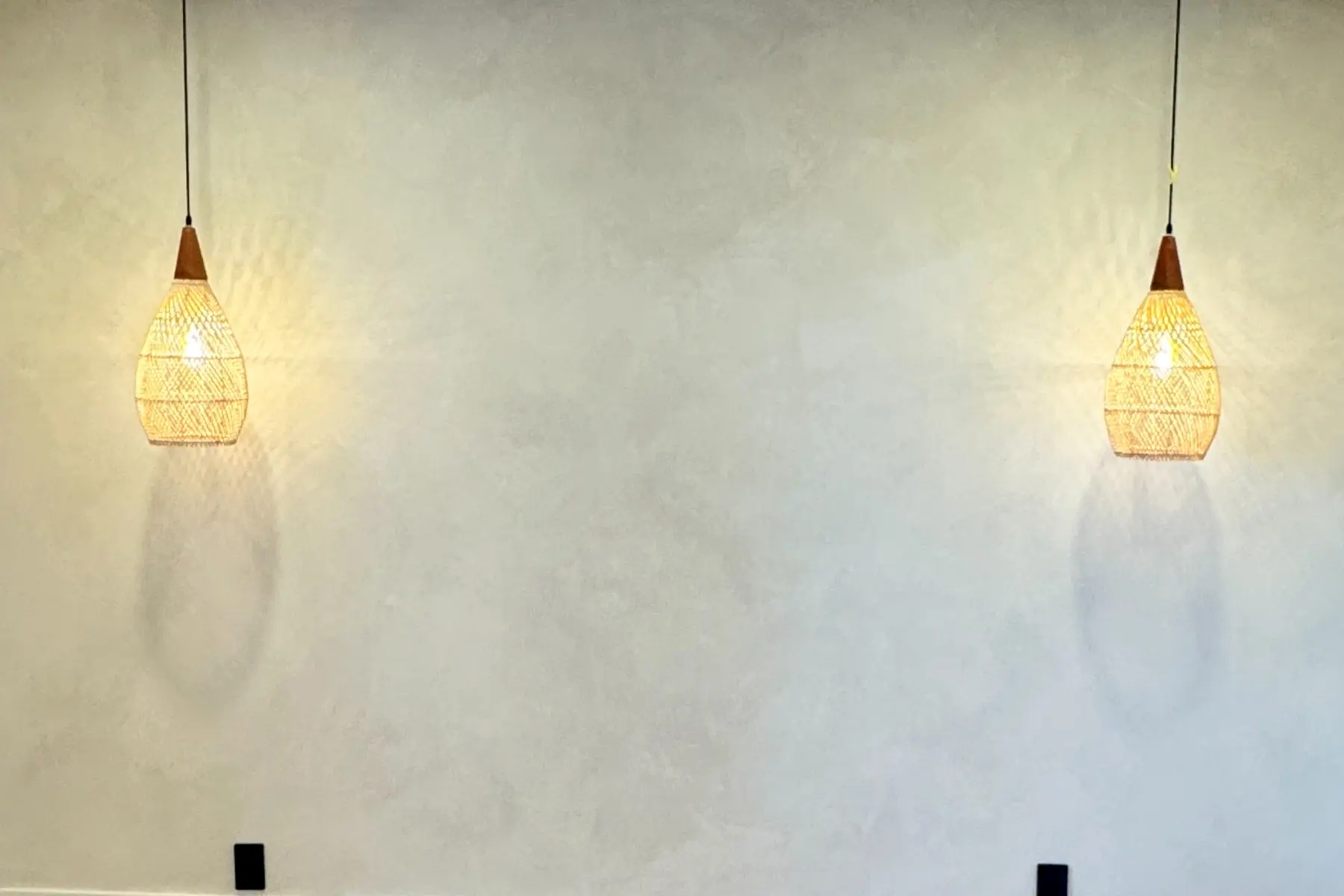
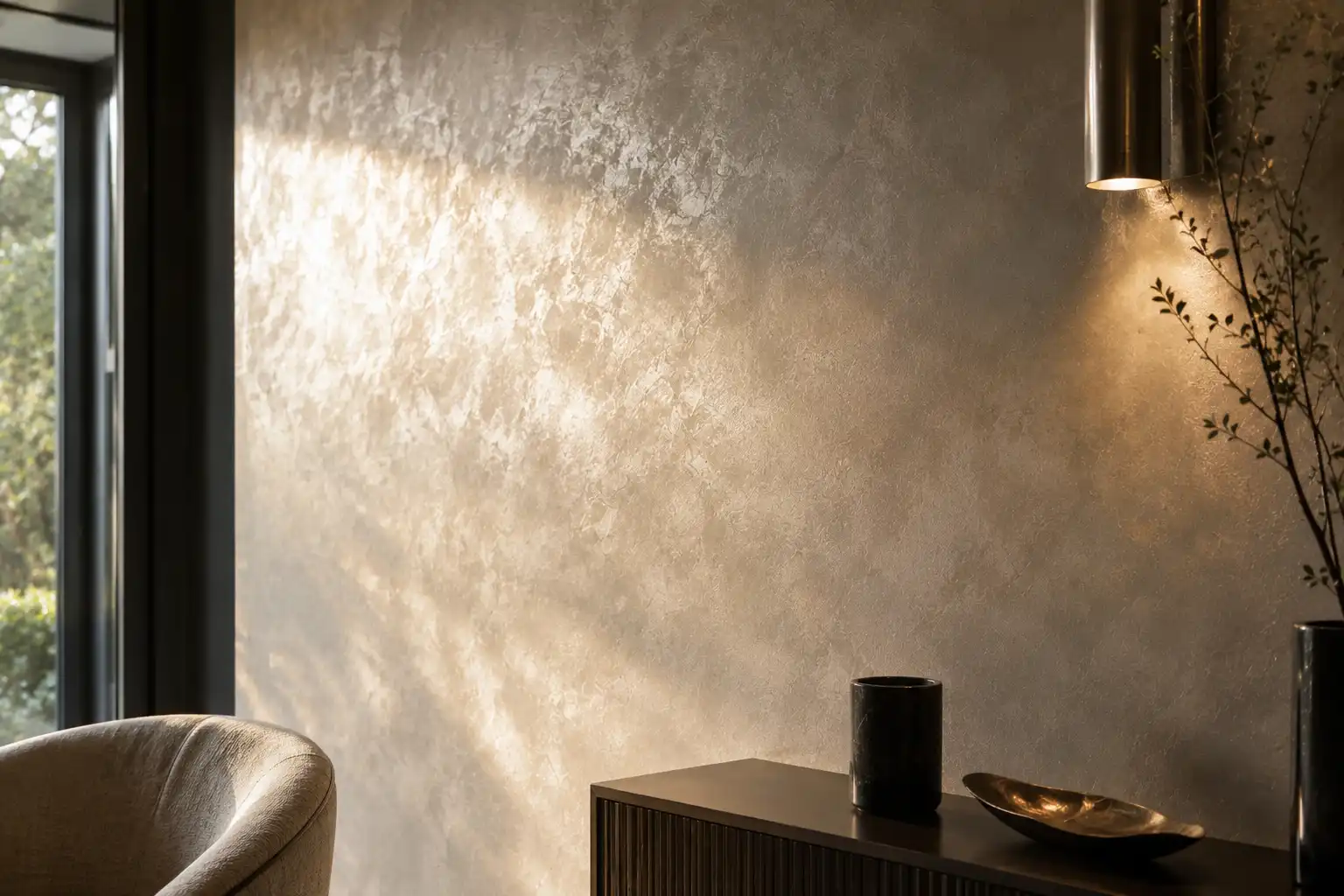
These two walls show how far mood can travel. On one side, a soft mineral finish with cloudy, breathing movement that recedes into the room and lets the light do the talking. On the other, a luminous surface that steps forward, catches the light and changes as you move past it. Same category - decorative wall finish - two completely different jobs. Naming which of those you want is the single most useful thing you can do before comparing products.
Know the seven finishes at a glance
It helps to have a plain-language sense of what each finish actually is before you match it to a room. You do not need to become an expert - that is our job - but a working picture of the family makes every later decision easier.
- Microcement - a thin, seamless cement-based system applied over floors, walls, showers and countertops. Continuous, contemporary and hard-wearing, with no grout lines to interrupt it.
- Venetian plaster - a family of lime plasters, including Marmorino, Travertino and Palladino, polished to a depth that reads like stone. The classic choice for dimensional, timeless walls.
- Lime wash - a breathable mineral finish with soft, cloudy movement. Matte, weathered and calm, it is the quietest way to add real depth to a wall.
- Roman clay - a smooth, low-sheen clay finish with subtle tonal movement. Refined and understated, it sits comfortably in high-traffic living spaces.
- Fluted finishes - vertical relief and rhythm applied to the wall itself, throwing soft shadow lines that change with the light.
- Metallic and pearl - luminous finishes such as Cadoro, Pearl Velvet and Velatura that catch and shift the light, built for accent walls and jewel-box rooms.
- Stone-effect plaster - dimensional plaster worked to read like natural stone, for walls that need real weight and presence.
Match the finish to how the wall is used
A feature wall behind a bed lives a very different life from a hallway that gets touched every day, or a powder room that meets moisture. This is where a lot of beautiful finishes get chosen for the wrong wall. The more hands-on and higher-traffic the wall, the more it favors tighter, harder-wearing finishes. The quieter and more protected the wall, the more freedom you have to choose for pure atmosphere.
Here is how the seven finishes tend to sort themselves once you factor in use:
- Soft, atmospheric walls - bedrooms, living rooms, quiet halls: lime wash for breathable, clouded movement that feels weathered and calm.
- Refined, higher-traffic walls - entries, media walls, powder rooms: Roman clay for a smooth, low-sheen surface with subtle depth that holds up to daily life.
- Seamless, hard-wearing surfaces - bathrooms, kitchens, floors: microcement built as a full bonded system rather than a single coat.
- Statement and depth - fireplaces, stair halls, dining walls: Venetian plaster or a stone-effect surface for real dimensional presence.
- Light and luxury - luminous accents and jewel-box rooms: metallic and pearl finishes, or fluted for rhythm and shadow across the surface.
Notice that traffic and moisture do most of the sorting. A finish does not have to be delicate to be beautiful, but the finishes built for movement and water - microcement and Roman clay in particular - earn their place in the busy rooms, while lime wash and the more sculptural plasters get to shine where the wall is admired more than it is handled.
A quick word on bathrooms and kitchens
Wet and high-use rooms deserve special care, because here the surface you see is only part of the story. What protects a microcement shower or a plaster splash zone is the full system underneath and the sealing on top, not the decorative layer alone. If your shortlist includes a bathroom or a kitchen, treat the finish and its system as one decision. The right specialist will talk to you about preparation, waterproofing and sealing in the same breath as color and texture - because in a wet room, the invisible work is what keeps the visible work beautiful.
Read the light in your own room
Orange County light is a gift and a complication. It shifts through the day - bright and flattening at noon, long and warm at dusk - and a finish that looks perfect in one of those moments can read differently in another. This is why the same finish behaves differently on your wall than on someone else's. The orientation of the room, the size of the windows, the color of the floor bouncing light back up: all of it changes how a finish reads.
As a rule of thumb, matte mineral finishes - lime wash, Roman clay, the softer plasters - soften and diffuse light. They calm a bright room and add quiet depth to a dim one. Metallic and pearl finishes do the opposite: they catch light and change as you move, which makes them spectacular on an accent wall and overwhelming across an entire room. Fluted finishes add a third dimension entirely, using real relief to throw soft shadow lines that shift with the sun. None of this is visible in a flat photo taken in someone else's house.
A simple test helps here. Before you commit, look at the wall you have in mind at three moments: mid-morning, mid-afternoon and just after the lights come on in the evening. If a wall only gets strong light at one time of day, lean toward a finish with its own internal movement - lime wash or a polished plaster - so the surface stays interesting even when the light goes flat. If a wall is bathed in changing light, a metallic or fluted finish will reward it all day long.
The right finish is the one that reads correctly in your room, in your light - not the one that looks best in someone else's photo.
SBK Group
Think about the whole home, not just one wall
Open-plan Orange County homes reward a little planning across rooms. When a living area flows into a dining space and on into a hallway, the finishes should feel like a family rather than a set of unrelated choices. That does not mean using the same finish everywhere - it means choosing finishes that share a temperature and a level of quiet, so the eye moves through the home without a jolt.
A common and successful pattern is to choose one calm, matte finish as the home's background voice - a lime wash or a soft Roman clay carried across the main living spaces - and then let a single, more dramatic finish take one deliberate moment: a Venetian plaster fireplace, a metallic powder room, a fluted entry wall. The restraint is what makes the statement land. When every wall shouts, nothing is heard.
Transitions matter too. Think about where one finish stops and another begins - at an inside corner, a doorway, a change of plane - so the edges feel intentional. A good finish specialist plans these breaks with you, rather than letting them fall wherever the drywall happens to end.
Color is chosen on the wall, never on a screen
It is tempting to pick a color from a photo or a digital swatch and consider the decision made. With hand-applied finishes, that is where people get surprised. These materials have depth and movement, so the color you end up with is the result of pigment, technique, the number of layers and the light in the room - not a single flat value. A lime wash can drift a full shade lighter as it cures. A polished plaster can read warmer or cooler depending on how the light rakes across it.
This is why a physical, hand-applied sample board matters so much, and why a digital preview is only ever a starting point for the conversation. The sample lets you see the real material, in your real light, at the real scale - and it lets you and your finish specialist agree on exactly the look you are chasing before any wall is touched. A screen can narrow the field; only the wall can settle it.
Plan for how the finish will live over time
Every wall in a lived-in home ages. The good news with hand-applied mineral finishes is that they tend to age gracefully - they patina rather than peel, and small marks can often be softened into the surface rather than repainted over. Different finishes ask for different care, though, and it is worth knowing that before you choose.
Sealed microcement in a shower is built to be wiped down and lived on. A breathable lime wash in a bedroom is happiest left alone, developing a soft depth as it settles. A polished Venetian plaster wants gentle cleaning and rewards you with a surface that only looks richer with age. None of this is demanding, but matching the finish to how much upkeep a room realistically gets - a busy kitchen versus a formal sitting room - is part of choosing well. Ask your specialist how each shortlisted finish behaves a year and five years in, not just on day one.
Confirm it by hand before you commit
Once the shortlist is down to one or two finishes, the last step is a hand-applied sample on your actual wall, viewed across a full day. That is when the finish stops being an idea and becomes a decision you can trust. You see how it holds the morning light and the evening light, how the color settles, how the texture reads at arm's length and from across the room.
This final step is also where a good specialist earns their keep. Choosing a finish is not really about memorizing the difference between Marmorino and microcement - it is about matching a material to a room, a use and a light, and then executing it by hand so the result looks inevitable. If you get the mood right, respect how the wall is used, read your own light, and confirm the color and texture in your own space, the finish will feel like it was always meant to be there. That is the whole goal: not a wall that impresses in a photo, but a room that feels right every time you walk into it.
Let us help you choose
Tell us the room and the look you are after, and we will bring hand-applied samples and turn it into a written estimate.
Not sure which finish fits your room
Tell us the room and the feeling you are after, and we will bring hand-applied samples and turn it into a written estimate.