
Choosing a finish
Which Finishes Work Best in Bathrooms and Wet Areas
Moisture, splashes and daily use ask more of a wall. Here are the hand-applied finishes that hold up in Orange County bathrooms, and why the full applied system matters far more than the surface name.
9 min read
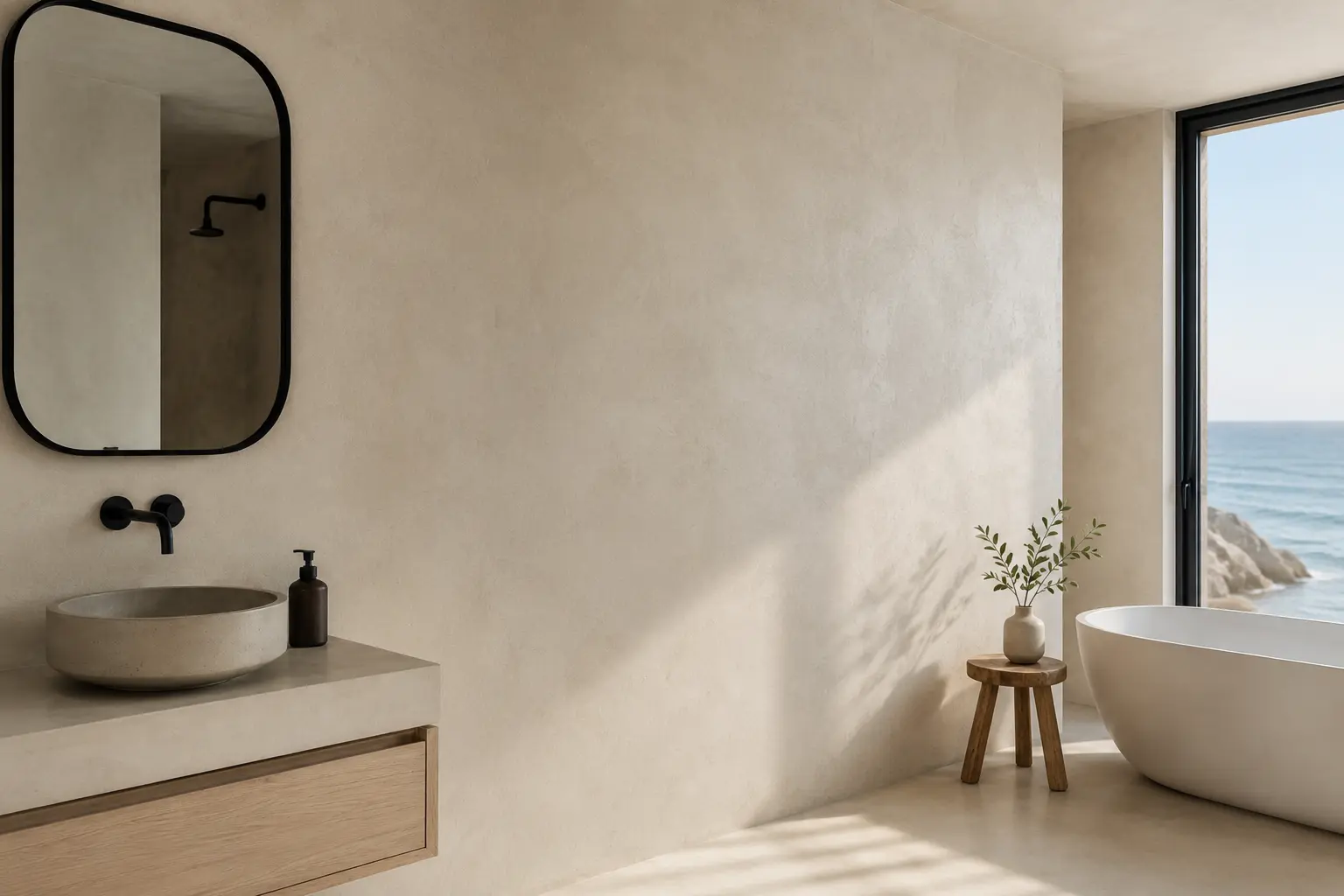
Bathrooms and wet areas ask more of a wall than any other room in the house. Moisture in the air, splashes at the basin, spray in the shower, steam that lingers after a hot bath, and the daily habit of wiping surfaces down all test a finish over months and years. A wall that looks flawless on the day it is finished has to keep looking that way through everything a real bathroom puts it through.
The good news is that several hand-applied decorative finishes are genuinely well suited to these rooms. The catch is that suitability depends far less on the surface name and far more on how the finish is built. A finish that fails in a shower and a finish that lasts for years can carry the exact same label. The difference is the system underneath and the protection on top.
This guide walks through how to think about finishes for bathrooms and wet areas: why the applied system matters more than the surface name, which finishes suit which zones, and the practical questions worth asking before you commit. If you want to see the full range first, start with our finishes overview.
Why the system matters more than the surface
When people choose a bathroom finish, they usually focus on the look - the color, the movement, the sheen. That is understandable, because the look is what you live with. But in a wet area, the look is only the visible top of something larger. What actually protects the wall is the whole build-up: the preparation of the substrate, the body of the finish applied in hand-worked layers, and the protective coats that seal and harden the surface against water and cleaning.
Think of it the way you would think about a floor. Two floors can be the same species of wood and look almost identical, yet one is sealed for a busy kitchen and the other is left raw for a quiet study. Same material, very different performance, because the system around it was planned for a different job. Bathroom finishes work the same way. The surface name tells you the character. The system tells you whether it will last.
This is why a finish specialist plans the build for the specific room rather than reaching for one recipe. A powder room that never sees a shower does not need the same protection as a wet-room wall that gets sprayed every morning. Matching the system to how the room is actually used is the single most important decision, and it happens before any color is chosen.
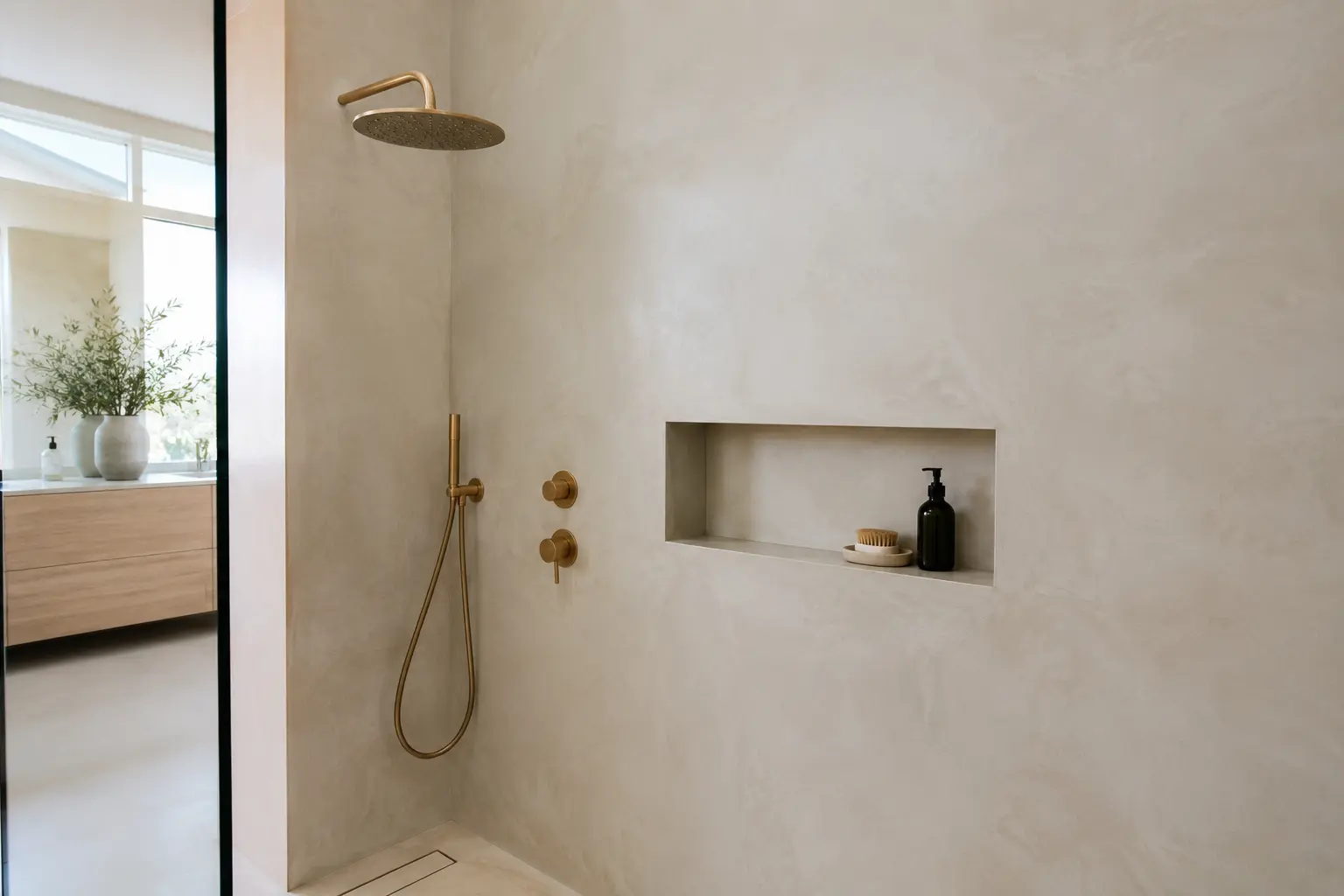
Microcement - the seamless option
Microcement is often the first finish worth considering for a genuinely wet space, and the reason is structural rather than decorative. It is seamless. There are no grout lines to trap grime, no joints where water can work its way behind the surface, and no repeating tile pattern to interrupt the eye. Applied as a full system, it can wrap walls, floors and shower surrounds in one continuous, hard-wearing surface.
That continuity is what makes it feel so calm and modern. A tiled shower is a grid of small parts; a microcement shower reads as a single quiet plane of color and soft texture. In a lot of Orange County homes - the clean-lined new builds, the pared-back remodels, the coastal-modern interiors - that seamless quality is exactly the look people are after. It suits the architecture instead of fighting it.
What matters most with microcement in a wet area is that it is installed as a complete system: correct substrate preparation, a reinforced base, the hand-troweled body coats that give it depth, and the sealing layers that make it water-resistant and easy to clean. Skip or rush any of those stages and the finish that looked identical on day one will not behave the same over time. This is the clearest example of why the system, not the name, decides how a bathroom finish performs.
Where microcement earns its place
Microcement is at its strongest in the zones that see the most water and the most cleaning: shower walls and surrounds, splash areas behind a basin, and floors that need to shrug off puddles and foot traffic. Because it is continuous, it is also the natural choice when you want walls and floor to flow together without a visual break, which makes a small bathroom feel larger and a large one feel serene.
Roman clay - refined walls beyond the splash zone
Roman clay plays a different role in a bathroom. It is a smooth, troweled finish with a low sheen and a quiet, modern depth. It is not the finish you reach for inside a shower enclosure, but it is a beautiful choice for the walls of the room beyond the splash zone - vanity walls, the wall behind a freestanding tub, powder rooms and half-baths where moisture is present but direct spray is not.
What makes Roman clay work in these spaces is the way it holds up to touch and wiping while still reading as soft and hand-worked. It gives a powder room a sense of refinement that flat paint simply cannot, and it does so without any high-gloss shine that would feel cold or clinical. In a guest bath, where you want a moment of quiet luxury more than heavy-duty waterproofing, it is often the perfect fit.
As with microcement, the protection around Roman clay is what tunes it for a bathroom. Sealed appropriately for the room, it becomes a wipeable, hard-wearing surface. The character of the finish stays the same; the system adapts it to the humidity and cleaning the space will see.
Where Venetian plaster fits
Venetian plaster and its family of finishes bring more depth, movement and, in some sub-types, more sheen. In a bathroom, this is where you make a feature rather than cover the wettest surfaces. A polished Venetian wall behind a vanity, or on a single feature wall in a large primary bath, can turn the room into something that feels closer to a spa than a utility space.
The same rule applies: the further a finish sits from direct water, the more freedom you have. Venetian and its sub-types are best treated as the statement in a bathroom - the wall that draws the eye - rather than the workhorse surface in the shower. Paired with a seamless system in the wet zones, it lets you have both refinement and durability in the same room, each finish doing the job it does best.
How to think about it for your room
Rather than starting from a finish name, it helps to start from the room and how each part of it is used. Map the space by how wet each zone gets, then match the system to the zone. A simple way to think about it:
- Wettest zones - showers, tub surrounds and splash areas: seamless systems like microcement, built and sealed as a complete wet-area build.
- Vanity and powder-room walls: microcement or Roman clay for a refined, wipeable surface that handles humidity without direct spray.
- Feature walls in larger baths: Venetian plaster and its sub-types, placed away from the water as the room's focal point.
- Guest and half-baths: the widest range of finishes opens up, since moisture is low and there is no shower to plan around.
The point of mapping the room this way is that most bathrooms are not a single condition. They are a wet zone, a damp zone and a dry zone all in one space. The best result usually comes from using more than one finish - a seamless system where the water lands, and a more decorative finish where it does not - rather than forcing one surface to do every job.
Questions worth asking before you commit
A short conversation up front prevents most bathroom-finish regrets. Before work begins, it is worth being clear on how the room is ventilated, how often each wall will be cleaned and with what, whether the shower is enclosed or open, and how much movement or sheen you want in the finish. Those answers shape the system as much as the color does.
It is also worth confirming the look the only reliable way there is: on a hand-applied sample, on your own wall, in your own bathroom light. Bathroom lighting is often brighter and cooler than the rest of a home, and it changes how a finish reads. A sample board resolves that before the full job, not after.
In a wet area, compare the finished system - preparation, the body of the finish, and the protection around it - not just the surface name.
From the SBK finishes guide
Living with the finish: cleaning and care
A bathroom finish is only as good as it is easy to live with, and this is where a properly built system quietly pays off. A sealed microcement wall wipes down like a continuous surface, with none of the grout scrubbing that tiled showers demand over the years. There is simply less for grime to catch on, which is one of the underrated reasons seamless finishes suit busy family bathrooms so well.
Day-to-day care is gentle by design. A soft cloth and a mild, non-abrasive cleaner keep a decorative bathroom wall looking its best; harsh scouring products and rough pads are the things to avoid, because they work against the sealed surface rather than with it. The right cleaning routine is part of the system too - the protection is planned to be maintained simply, not fought against.
Ventilation matters more than most people expect. A bathroom that clears steam quickly asks less of every surface in it, finish included. Good extraction, a cracked window, or simply wiping down a shower after use all extend the life and look of the wall. None of this is demanding, but it is worth knowing up front, because the way a room is used and aired is part of what keeps the finish performing.
Common mistakes to avoid
Most bathroom-finish problems trace back to a handful of avoidable decisions, and knowing them in advance saves disappointment later. The most common is treating a decorative finish like paint - choosing it for the look alone and assuming any applicator will deliver the same result. In a dry room that assumption is survivable. In a wet area it is the difference between a wall that lasts and one that does not.
A second mistake is putting the wrong finish in the wettest zone - asking a wall finish meant for dry or damp areas to hold up to direct shower spray. The fix is not a different color; it is the right seamless system in the wet zone and the decorative finish kept beyond the splash. Trying to force one surface to do every job in the room is where regret usually starts.
The third is skipping the sample. A finish that looks perfect in a showroom, a photo or a friend's home can read completely differently in your own bathroom light, against your own fixtures, at the scale of your own walls. Confirming the look on a hand-applied sample in the actual room is the cheapest insurance there is against a result that is technically well made but not what you pictured.
The takeaway
Bathrooms are the most demanding rooms a decorative finish can face, but they are far from off-limits. Microcement gives you a seamless, hard-wearing surface for the wettest zones. Roman clay brings refinement to the walls beyond the splash. Venetian plaster and its family make a feature where water does not reach. In every case, what decides whether the finish lasts is not the name on the tin - it is the system a finish specialist builds for your specific room.
Choose the finish for the mood you want, then let the system be planned for how the room is really used. Get those two things right and a decorative bathroom wall will look as good years from now as it did the day it was finished.
Talk through your bathroom
Tell us how the room is used and we will recommend a system and turn it into a written estimate.
Planning a bathroom finish
Tell us about the room and how it is used, and we will recommend a system and turn it into a written estimate.