
Finishes explained
Can You Apply Microcement Over Tile?
Yes, microcement can go over existing tile - and that is often the point. Here is what the tile-over job depends on, where it works, and how the seamless surface is built.
9 min read

Microcement over tile is one of the most common questions we hear from Orange County homeowners planning a bathroom or kitchen refresh. The short version is yes, in most cases microcement can be applied directly over existing tile, and that is often the reason people choose it in the first place. Tearing out old tile is dusty, slow, and disruptive. A hand-applied microcement system can go straight over the top and leave a seamless, grout-free surface behind. What makes that work is not the material on its own but the preparation underneath it. If you want to see how microcement sits alongside the other options, start with our overview of all finishes. This article walks through when a tile-over job is a good idea, what has to happen first, and where it is smarter to remove the tile instead.
Can microcement go over tile?
Yes. Microcement is designed to bond to a stable, well-prepared surface, and existing tile is often an ideal candidate because it is rigid, flat, and already fixed to the wall or floor. The tile becomes the substrate. Rather than demolishing it, the specialist masters key the surface, bridge the grout lines, and build the microcement up in thin layers until the tile disappears completely. What you are left with looks and feels like a single continuous plane, with no grout, no visible seams, and none of the pattern of the tile beneath.
The important word is stable. Microcement is a thin, hard-wearing skin, usually only a couple of millimeters thick across several coats. It has almost no ability to hide movement. If the tile it sits on is loose, drummy, or fixed to a base that flexes, that movement will eventually telegraph through. So the real question is never simply whether microcement can go over tile. It is whether this particular tile, in this particular room, is a sound enough base to carry a seamless finish for years.
What lasts is the system underneath, not the surface you can see.
What has to happen first: prep and bonding
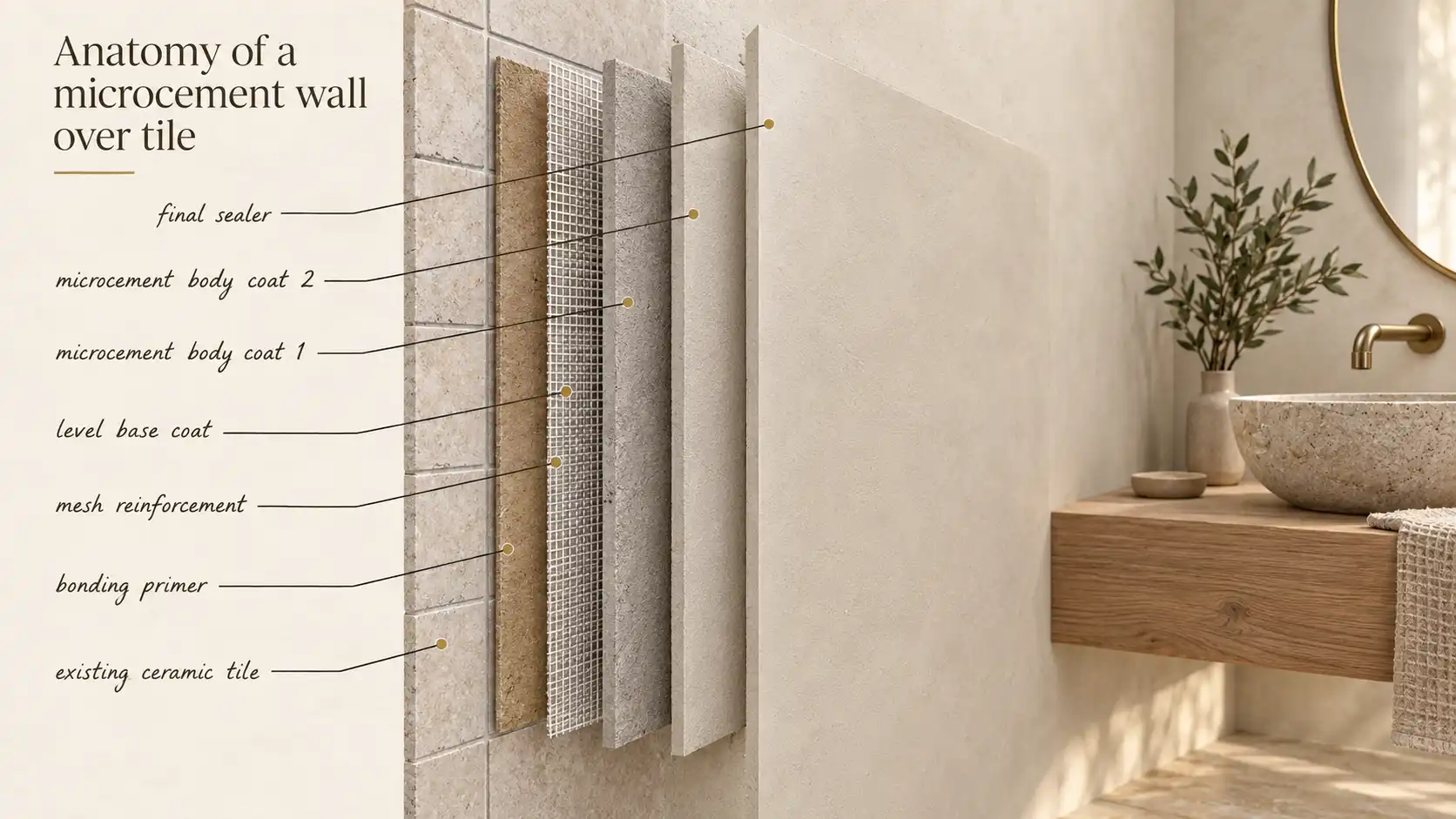
Before any microcement goes down, the tile has to be turned into a surface the material can grip and stay bonded to. This preparation is the entire job. Skipping or rushing it is the single most common reason a tile-over finish fails, and it is usually the part a thinner quote is quietly leaving out.
- Sound-check the tile. Every tile is tapped and inspected. Loose or hollow-sounding tiles are removed and the void is filled and leveled, because a tile that is already lifting will not hold a finish on top of it.
- Clean and de-grease. Bathrooms and kitchens leave behind soap, oils, and cleaning residue that stop anything bonding. The surface is thoroughly cleaned and, where the glaze is very slick, abraded so it is no longer glass-smooth.
- Apply a bonding primer. A specialist primer keyed to glazed surfaces gives the microcement something to grip. This is where material choice matters, and where SBK works with systems such as Meoded and San Marco rather than generic products.
- Bridge the grout lines. The recesses between tiles are filled and, on wider or deeper joints, reinforced with a mesh so the grout pattern cannot ghost back through the finished surface.
- Build a level base coat. A reinforced base layer ties the whole plane together before the finish coats begin, so the microcement works as one continuous membrane rather than a film laid over a grid.
Only once that base is flat, bonded, and fully cured do the finish coats go on. Those final layers are where the color, the movement, and the sheen live, and they are worked by hand so the surface reads as natural stone or poured concrete rather than paint. The tile below is, by that point, simply the frame the finish is built on.
Where it works and where it does not
Microcement over tile works best where the tiled surface is already solid and the room is not subject to heavy structural movement. It is an excellent choice for tiled bathroom walls, backsplashes, floors on a rigid base, and feature areas where you want to lose a dated tile pattern without the mess of demolition. It is the wrong choice where the existing tile is failing or the structure beneath it moves.
- Good candidates: tiled walls that are firmly fixed and flat, backsplashes, powder rooms, tiled floors over concrete or a stable screed, and any tile you simply want to modernize without a teardown.
- Approach with care: floors over timber joists that flex underfoot, tiles with cracks already tracking through them, and expansion or movement joints, which have to be honored in the new surface rather than covered over.
- Better to remove first: tile that is widely loose or debonding, surfaces with active water damage behind them, and any base that cannot be made genuinely stable. In those cases the tile is the problem, and putting a seamless finish over a moving base only hides it for a season.
None of this is a reason to be nervous about the idea. It is the reason a proper assessment comes before a quote. A finish specialist who looks at your actual tile can usually tell you in a single visit whether it is a sound base or whether a small amount of removal will save you a much larger repair later.
Tile in showers and wet areas
In a shower or other wet area, microcement can absolutely go over tile, but waterproofing becomes the deciding factor rather than the finish itself. Microcement is water-resistant once sealed, not waterproof on its own. The waterproofing is a separate system that sits beneath it, and in a wet area that hidden system is what actually protects the wall.
On an existing tiled shower there are two honest paths. If the original waterproofing behind the tile is intact and the tile is sound, a microcement system with the correct wet-area primers and sealers can be built over it to give you the seamless, grout-free shower people ask for. If there is any doubt about what is behind the tile, the responsible route is to take the tile back, confirm or renew the waterproof membrane, and then apply microcement over the new base. A seamless surface is only as good as the waterproofing it protects.
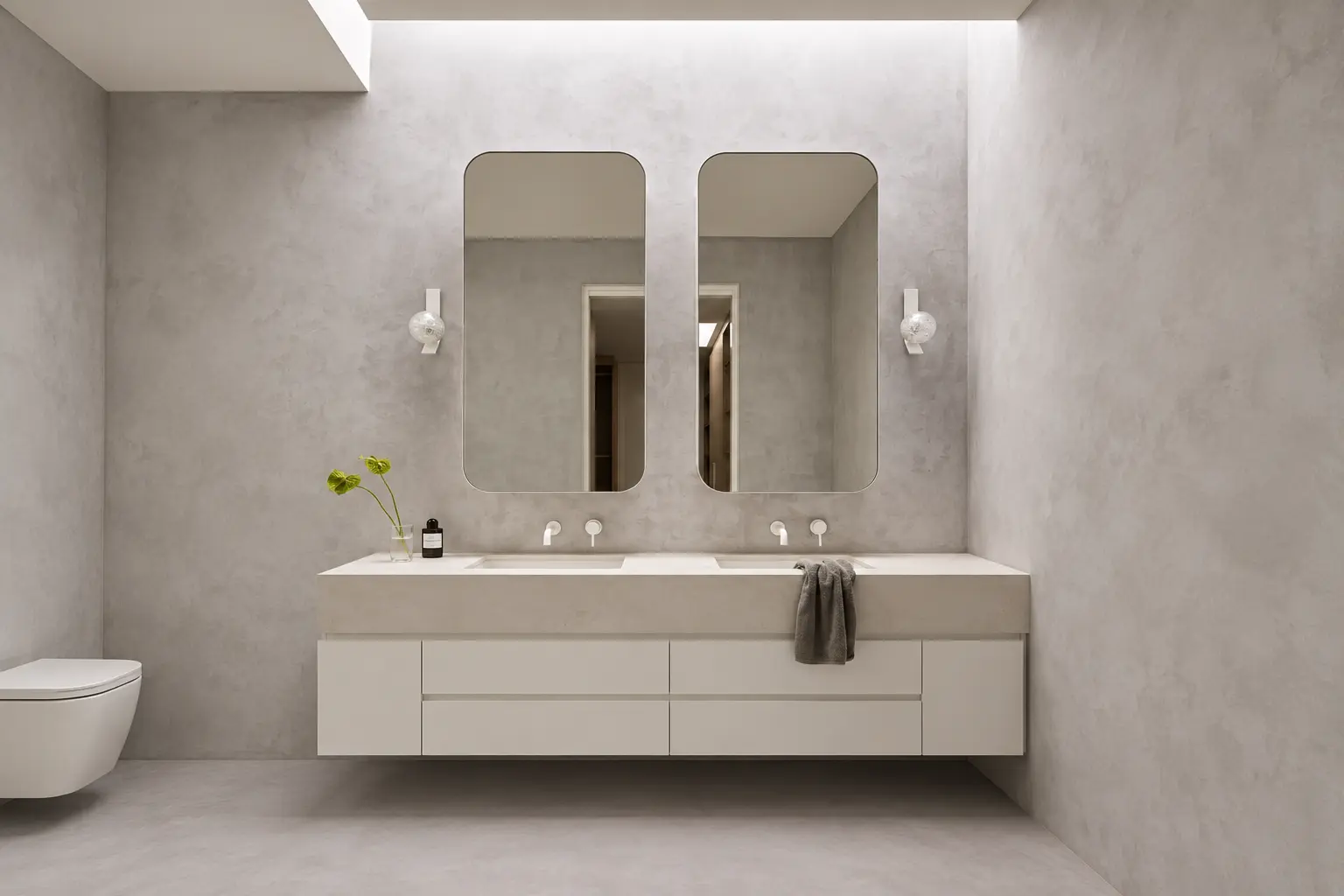
A microcement shower earns its reputation from the layers you never see: the membrane, the primers, and the sealer that make a hand-worked surface behave in daily use.
SBK Group
Sealing is the other half of wet-area performance. The finished microcement is protected with penetrating and topical sealers suited to the room, and that protection is renewed over the life of the surface. Cared for this way, a microcement shower stays easy to clean precisely because there is no grout to hold water, soap, or mold.
Common mistakes with tile-over microcement
Most problems with microcement over tile trace back to preparation, not the material. When a tile-over finish disappoints, it is almost always because a step underneath was skipped to save time or money. Knowing what those steps are makes it easy to tell a thorough quote from a thin one.
- Going over loose tile. Applying a seamless finish on top of tiles that are already drumming or lifting all but guarantees the movement shows through. Sound the tile first, or remove it.
- Ignoring the grout lines. Grout recesses that are not properly filled and bridged can ghost back as faint lines months later. The base coat has to erase the grid, not sit on top of it.
- Skipping the right primer. A generic primer on a glazed surface is a bond waiting to fail. The primer has to be matched to tile.
- Treating microcement as waterproofing. It is water-resistant when sealed, not a substitute for a proper membrane in a shower. The waterproofing belongs underneath the finish.
- No sample in the room. Color and movement read differently in your own light. Approving a hand-worked sample on site prevents surprises once the full wall is finished.
How a tile-over microcement surface holds up
A microcement surface applied over sound tile is just as durable as one applied over any other properly prepared base. Because the finish is bonded as a continuous membrane rather than sitting in a grid of grout, there are no joints to loosen, no grout to discolor, and no lines for water or dirt to collect in. Day to day it behaves like a hard mineral surface: wipe-clean, resistant to knocks, and forgiving of ordinary household use in a busy home.
Longevity comes from the sealer as much as the microcement itself. The topcoat takes the wear, and it can be refreshed periodically without redoing the finish beneath it, which is what keeps a hand-worked surface looking settled for many years. On a floor, a slightly more robust sealing schedule suits the traffic; on a wall or backsplash, the finish asks very little of you. The one thing that ages a tile-over surface badly is a base that was never stable to begin with, which is why the assessment at the start matters more than any product name on the label.
Does going over tile change the thickness or the thresholds?
Only slightly, and it is easy to plan for. Microcement over tile adds just a few millimeters to the surface, so on walls and backsplashes the change is visually invisible and has no practical effect on the room. On floors, that small build-up is worth thinking about at doorways, thresholds, and around fixed fittings, so the transition to an adjoining floor stays clean and level rather than stepped.
This is one more reason the room is assessed before any work begins. Where a floor meets a door, a shower tray, or a run of cabinetry, the specialist plans how the new surface will terminate so nothing reads as an afterthought. Handled at the start, the added thickness becomes a detail no one ever notices. Ignored, it is exactly the kind of small thing that can undermine an otherwise flawless finish, which is why the seamless look people love is really the product of careful edges as much as beautiful faces.
How SBK approaches a tile-over job
SBK treats a tile-over job as a preparation project first and a finish second. Before we quote, a specialist assesses the tile in the room where it lives: how sound it is, what is behind it, how the room is used, and how light falls across the wall. Across Orange County bathrooms, kitchens, and powder rooms, that assessment is what decides whether the tile stays as a base or whether a small removal is the smarter investment.
From there the work follows the same discipline on every surface. The tile is made sound, cleaned, and primed with a system matched to a glazed base. Grout lines are bridged and reinforced. A level base coat unifies the plane, and only then do the hand-worked finish layers go on, sampled in your own room's light so the color and movement are approved before the full surface is committed. The result is a continuous microcement surface where no one would guess there is tile underneath. To see the full system and the finishes we build this way, visit our microcement service page.
Thinking about microcement over your tile?
Tell us the room and send a few photos of the existing tile, and we will tell you honestly whether it is a sound base or whether a small removal is the smarter move.
The takeaway: it is the system, not the tile
Microcement over tile is not a shortcut and it is not a gamble when it is done properly. It is a genuinely good way to retire a dated tiled wall, floor, or shower and replace it with a calm, seamless surface, without the noise and cost of a full teardown. Whether it is right for your room comes down to one thing: is the tile a stable enough base, and if not, what small step makes it one. Answer that honestly and the finish will last. That is the whole philosophy behind how we work. What endures is the applied system underneath, not the surface you first admire.
See what microcement could do for your space
Share the room and the look you are after, and we will turn it into a written estimate for a seamless, grout-free finish.