
Finishes explained
Venetian Plaster in 2026: Why Designers Are Turning Back to Polished Walls
Searches for Venetian plaster nearly doubled in early 2026. The return is not about mirror gloss. It is about tactile walls, warm mineral color, and surfaces that change with the light.
12 min read
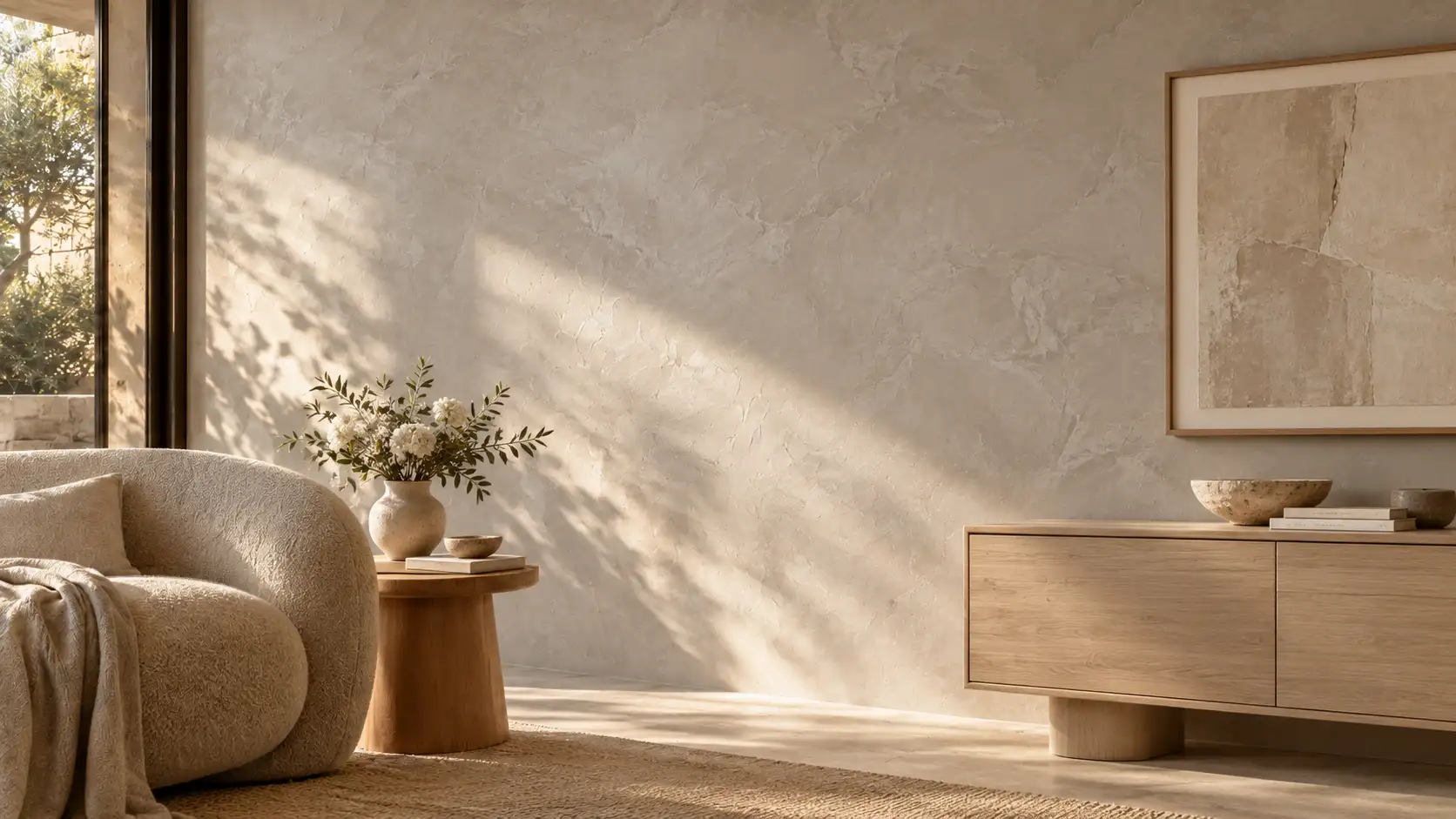
Venetian plaster is having a renewed moment in 2026, but the reason is not a return to the high-gloss faux finishes many people remember. The shift is toward walls that feel architectural, tactile, and alive in natural light. Designers are treating the wall as a material again rather than a painted background, and Venetian plaster, a family of hand-applied lime-and-mineral finishes, sits right at the center of that move. If you are weighing it against other options, our overview of all finishes puts it in context. This article looks at what the 2026 data actually shows, what has changed about how the finish is used, and where it does and does not belong.
The short answer: why is Venetian plaster trending in 2026?
Venetian plaster is trending because interior design is moving toward tactile materials, warmer palettes, and surfaces that show the human hand. Unlike flat paint, a properly applied Venetian wall is never visually static. Thin hand-troweled layers create soft tonal variation, and light reveals different parts of that movement as the day and the viewing angle change.
The search data supports the shift. In its 2026 U.S. Houzz Emerging Summer Trends Report, Houzz reported that searches for Venetian plaster rose 94 percent in January through March 2026 compared with the same period in 2025. The same report showed searches for sandstone up 257 percent, linen wallpaper up 104 percent, and limewash interior paint up 53 percent. Venetian plaster is not rising alone. It is part of a broad move away from uniform, factory-flat surfaces toward materials with texture, depth, and natural variation.
The wall is becoming a material again, not just a painted background.
It is not the glossy faux finish people remember
Much of the hesitation around Venetian plaster comes from an earlier era of heavily polished, high-contrast decorative walls that could read as busy or theatrical. Modern Venetian plaster does not have to look like that, and in most of the best current work it does not.
It helps to think of Venetian plaster as a family rather than a single look. Depending on the material, the aggregate, the number of layers, and how the surface is worked and burnished, the finished wall can range from a calm matte Marmorino to a refined polished surface with real luminosity. The character should come from the material itself, not from an applied effect. A well-executed Venetian surface typically shows:
- Soft cloud-and-trowel movement rather than a repeating pattern.
- Fine to medium mineral grain that reads up close and softens at a distance.
- Low surface relief, felt more than seen.
- Subtle tonal variation, never a printed or stenciled marble look.
- A light response anywhere from matte to satin to burnished, with depth that seems to come from inside the layers.
What it should not resemble is just as important. A good Venetian wall does not look like plastic lacquer, epoxy, printed stone, microcement, or ordinary flat paint. It has no coating-like film sitting on top. The depth is built into the layers, which is exactly why it reads so differently from anything rolled or sprayed.
Why designers are using polished walls again
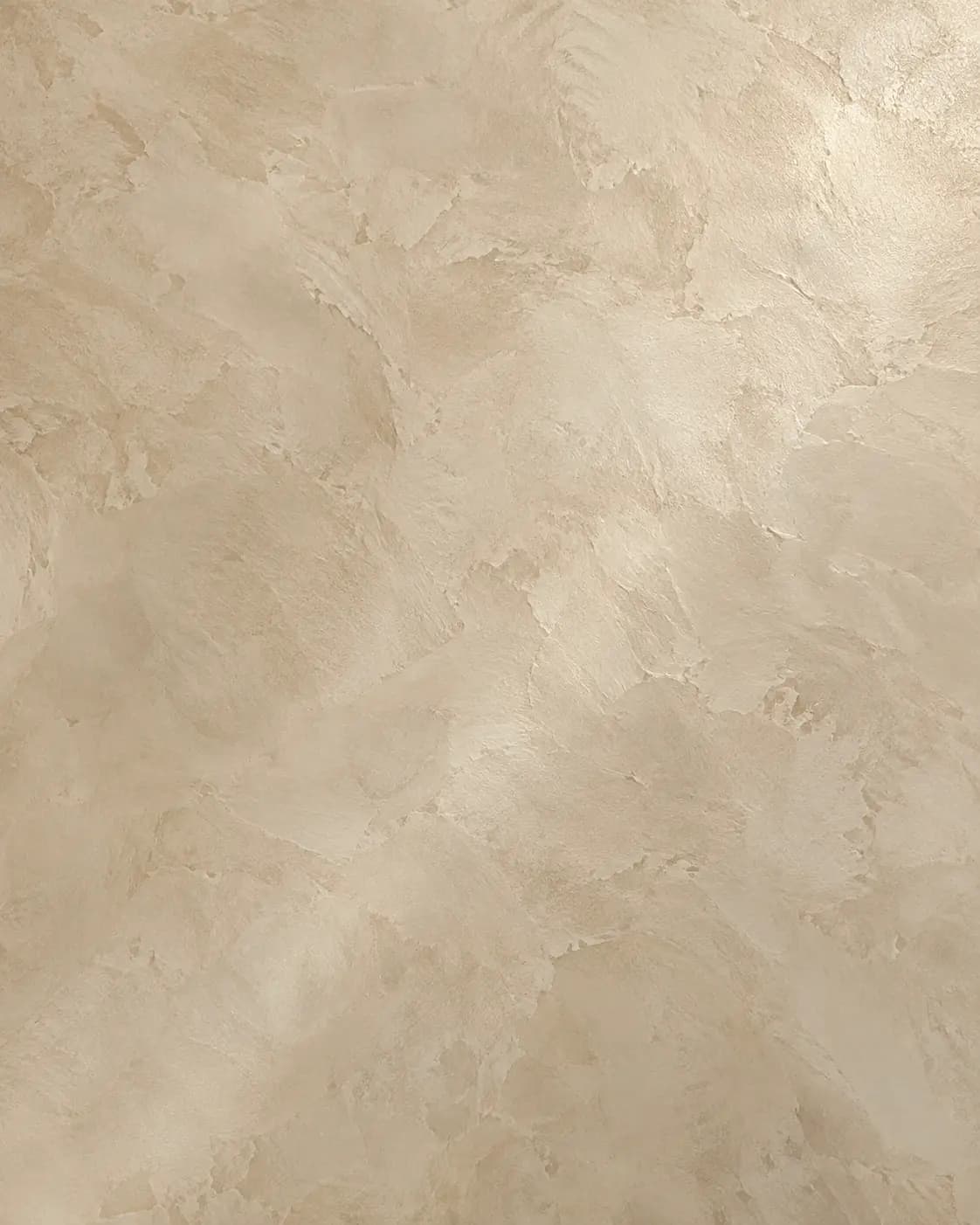
The word polished is easy to misread. The most compelling polished Venetian walls are not necessarily highly reflective. Burnishing compresses and refines the surface so that some areas hold light differently from others. That creates depth without any need for decorative pattern.
In a room with generous windows, the effect shifts through the day. A wall can look quiet and nearly matte in soft morning light, then reveal more movement when low afternoon sun rakes across it. That is why plaster works so well in architecture where daylight is already part of the design, and why it suits Southern California homes with large openings and strong, directional sun.
There is also a cultural reason. After years of surfaces that look digitally perfect, many clients want something that carries evidence of the hand. Venetian plaster introduces controlled irregularity. No stencil, no motif, no printed veining. The variation comes from the material, the application, and the light, and that restraint is what makes it feel current rather than nostalgic.
Warm mineral colors are replacing cold, flat neutrals
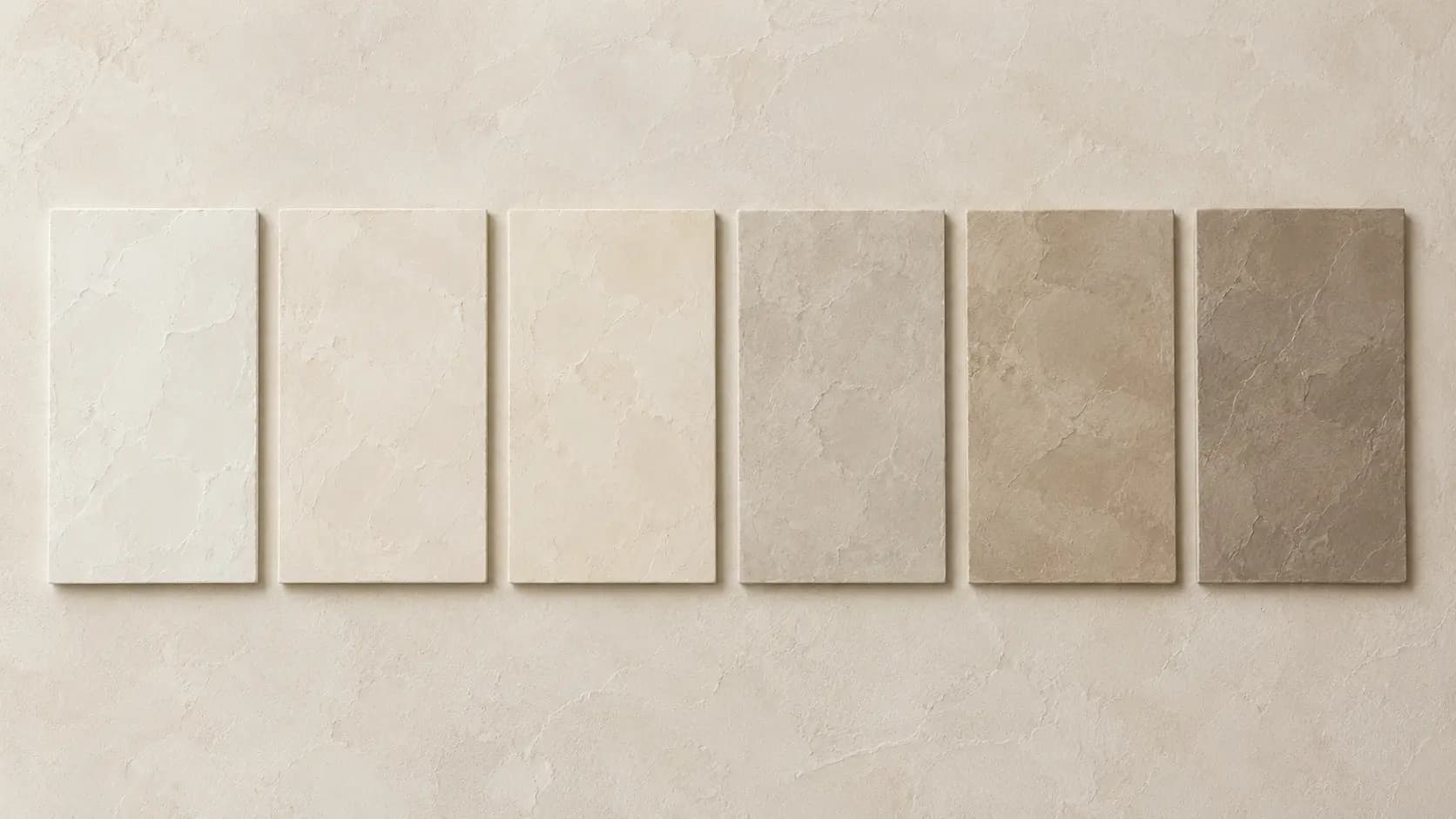
Color is the other half of the story. For several years, neutral interiors leaned on relatively cold whites and grays. The 2026 neutral is warmer and more layered. The same Houzz report recorded searches for mushroom color up 69 percent, taupe up 50 percent, and cream up 44 percent. Venetian plaster is naturally at home in that palette.
- Warm white, for bright interiors that need more depth than a standard white paint can give.
- Bone and ivory, for softer spaces where pure white feels too sharp.
- Limestone and sand, for Mediterranean, organic modern, and warm minimalist rooms.
- Mushroom, greige, and taupe, for rooms where the wall needs enough presence to define the architecture without taking over.
The key difference is that plaster color is always experienced together with movement and sheen. A taupe painted wall and a taupe Venetian wall can share a color family and still produce completely different rooms. The plaster has variation, light finds different parts of it, and even a restrained neutral gains depth. That is why color choices for plaster should always be made from a physical sample rather than a paint chip or a screen.
Matte Marmorino and polished Venetian share one design language
One of the clearest shifts in 2026 is that designers no longer treat Venetian plaster as one specific look. There is a spectrum. At one end sit refined matte finishes such as Marmorino, which feel soft, mineral, and close to natural stone. At the other are finer finishes that can take a stronger burnished polish. Between them are many combinations of grain, movement, and sheen.
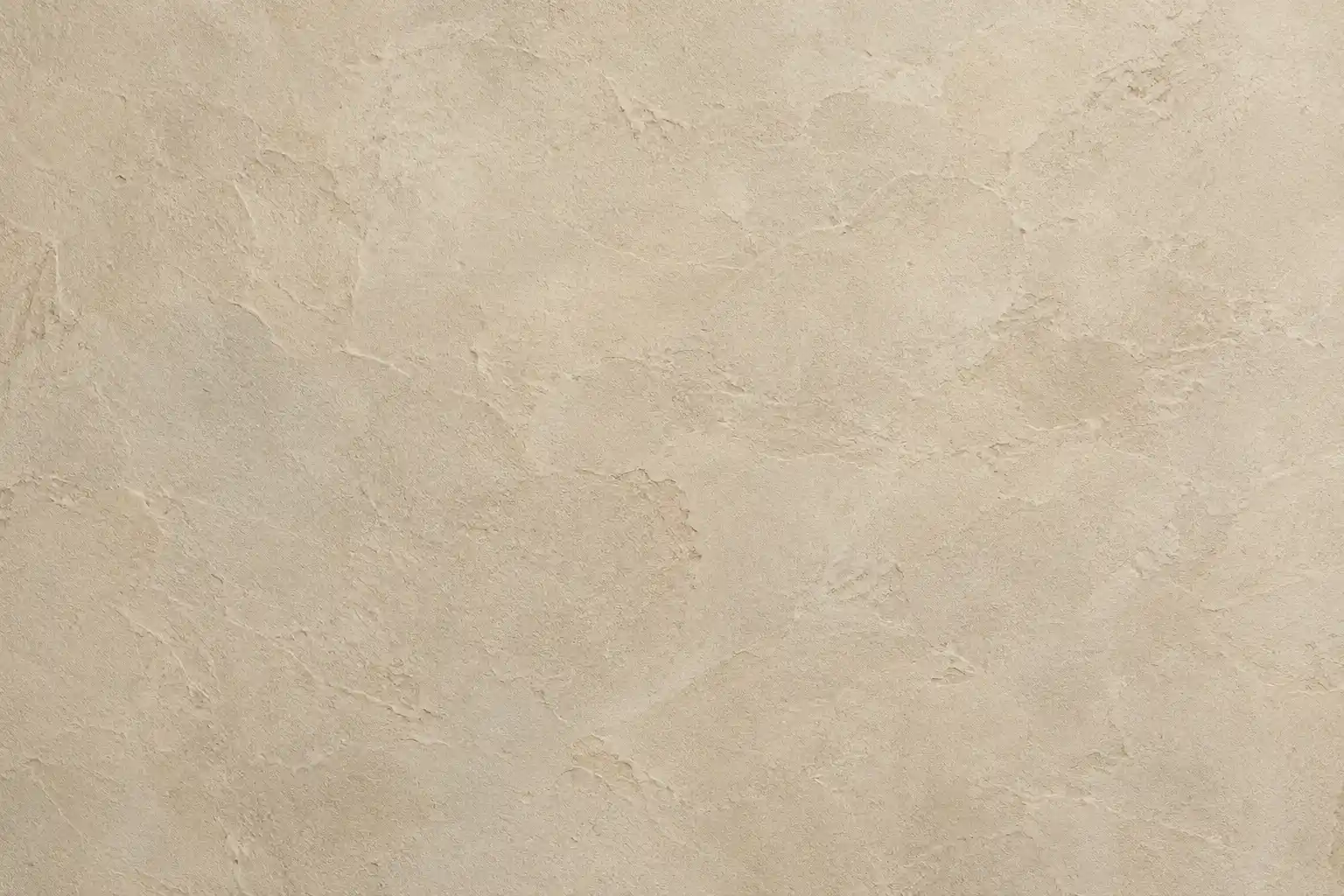
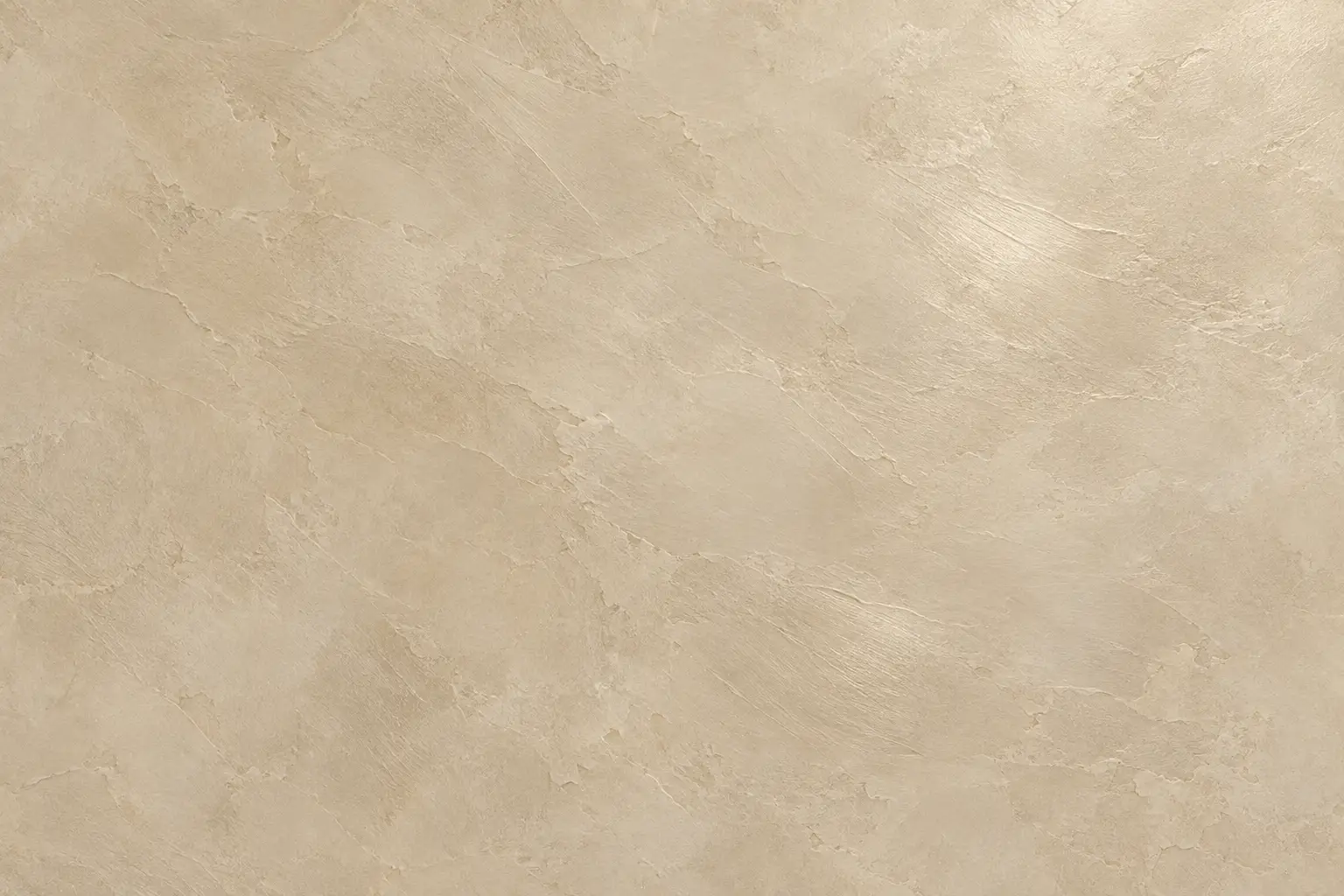
That range lets the same material family work in very different rooms, and it allows a single home to use more than one expression without feeling disjointed.
- A living room might use a soft matte mineral wall as a calm architectural backdrop.
- A dining room might take a more burnished finish so evening light brings out depth.
- A fireplace surround might carry slightly stronger movement to emphasize its geometry.
- An entry or stair hall can use changing viewing angles so the finish reveals itself gradually as you move through the space.
The best specification starts with the architecture and the light, not with a photograph of someone else's wall. The same finish can look noticeably different under north-facing daylight, strong west sun, or warm evening lighting.
Does Venetian plaster look different throughout the day?
Yes, and this is one of its defining qualities. A painted wall changes mainly with the amount and color temperature of the light falling on it. Venetian plaster also reveals differences in trowel movement and sheen as the angle of that light changes. Burnished areas catch grazing light. Matte areas stay quieter. Tonal movement becomes more visible from one position and softer from another.

This is why sample evaluation matters so much. A board viewed under showroom lighting is not enough to predict how a finish will behave in a particular home. In Orange County, strong natural daylight can reveal surface character quite differently from evening architectural lighting. The final color and finish should be confirmed from a hand-applied sample, placed on the actual wall, and looked at across a full day.
Approve the sample in the room, not in the showroom. The light in your home is part of the finish.
SBK Group
Where Venetian plaster works best
Venetian plaster is most effective where the wall has enough visual importance to justify a hand-applied finish. Common applications include feature walls, living and dining rooms, stair halls, entries, fireplace surrounds, bedrooms, and selected bathroom walls outside direct water.
It often does more across a large architectural plane than as a small decorative accent. Consider a tall stair wall. Painted, it simply marks the edge of the space. In Venetian plaster, light from an upper window creates shifting movement across the same surface through the day. The architecture stays simple, but the wall becomes expressive. Fireplaces follow the same logic: instead of adding a manufactured cladding, a continuous mineral surface supports the form of the fireplace itself.
For designers working with natural oak, limestone, travertine, linen, bronze, or warm stone, Venetian plaster is also a useful bridge between hard architectural materials and softer furnishings. It holds its own next to stone without competing with it.
Is Venetian plaster right for modern minimalist interiors?
Yes, and minimalism is often where it is strongest. It needs neither elaborate furniture nor classical architecture. In a pared-back room there are fewer competing materials, so the wall becomes the texture. A simple pairing of warm plaster, natural oak, limestone, linen upholstery, and a few dark or bronze accents gives a room depth while keeping it calm. That is why the current return should not be read as a return to decorative excess. The surface is sophisticated precisely because it does not need another layer of ornament.

Where Venetian plaster does not fit
Knowing where not to use a material is part of specifying it well. Venetian plaster should not be chosen simply because a client wants a luxury wall. The architecture, the substrate, the light, and how the surface will be used all matter.
- When the design calls for perfectly uniform color with no visible hand movement. A high-quality paint is the more logical choice there.
- Inside a direct-water shower. Bathroom walls outside direct water exposure can take appropriate Venetian systems, but shower interiors and true wet zones are better served by a wet-area microcement system.
- Over a damaged or uneven wall that has not been prepared. Thin decorative plaster does not make underlying problems disappear. The finished surface is only as good as the flatness and soundness of the wall beneath it.
- As a small token accent in a room that does not give it space or light to read. The finish needs a plane and a light source to do its work.
None of these are reasons to avoid plaster. They are reasons to specify it deliberately. That is the through-line of how we think about every finish: what lasts is the system, not the surface. Preparation, hand-worked layers, and the right protection for the room are what make a Venetian wall perform for years.
Venetian plaster vs lime wash in 2026
Both belong to the same broader movement toward natural-looking walls, and both appear in the 2026 search data, but they create different results.
Lime wash is softer, cloudier, and visibly brushed. It has a chalky matte character and tends to absorb light. Venetian plaster is built in troweled layers. Its movement is more composed, and depending on the finish chosen, it can reach considerably more depth and burnish. Choose lime wash when you want an intentionally soft, informal, cloudy mineral surface. Consider Venetian plaster when the wall needs more architectural refinement, controlled trowel movement, or a finish that can move from matte to polished. Neither should be treated as textured paint, and the choice is less about which is better than about which kind of movement and light response belongs in the room. Our lime wash service page covers that finish in more depth.
And vs microcement?
They are different systems entirely. Venetian plaster is a lime-and-mineral wall finish defined by layered trowel movement and burnished depth. Microcement is a thin cement-based system built for continuous, seamless surfaces, including floors and wet areas, with its own preparation and performance profile. For a side-by-side breakdown, see microcement vs Venetian plaster.
What drives the cost of Venetian plaster
Cost is one of the most common questions around any hand-applied finish, and the honest answer is that area alone does not set the price. Two rooms of the same size can carry very different scopes. The factors that move the figure most are the condition of the wall and how much preparation it needs, the number of layers and the level of polish, the technique within the Venetian family, the geometry and detailing of the surface, height and access, and the overall scope of the project.
We publish an installed range for Orange County, along with what sits at each end of it, on our Venetian plaster cost guide. A site visit and a sample then turn that range into a written estimate for your specific wall.
Considering Venetian plaster for a room?
Share a few photos of the wall and tell us how the light falls, and we will recommend a direction from matte Marmorino to burnished Venetian and prepare a sample for your space.
Is Venetian plaster just a trend?
Individual colors and styling choices will change. The qualities that make Venetian plaster useful are much less tied to a trend cycle. Hand-applied movement, mineral character, an honest response to natural light, and the ability to move between matte and polished are architectural qualities, not seasonal motifs.
That does not mean every room needs plaster. It means the material has a reason to exist beyond its current popularity. A carefully specified warm white Marmorino wall does not have to look like a 2026 trend a decade from now. It can simply look like a well-resolved material choice, which matters most in high-end interiors where longevity counts for more than following the moment.
Frequently asked questions
Is Venetian plaster still in style in 2026?
Yes. Houzz reported a 94 percent year-over-year rise in U.S. searches for Venetian plaster in early 2026, alongside growth in other tactile finishes such as sandstone, linen wallpaper, and limewash. The broader direction favors layered, material-rich walls.
Is polished Venetian plaster coming back?
It is part of the renewed interest, but current work rarely means mirror gloss. Most modern installations sit between matte Marmorino and a soft burnish, with the emphasis on depth and light response rather than maximum shine.
What Venetian plaster colors are popular in 2026?
Warm whites, bone, ivory, limestone, sand, mushroom, greige, and taupe. They match the wider shift toward warmer mineral neutrals and away from cold grays.
Should I choose matte or polished Venetian plaster?
Let the architecture and light decide. Matte creates a quieter mineral surface. A burnished finish interacts more strongly with changing light. Comparing physical samples on the actual wall is the most reliable way to choose.
Can Venetian plaster be used in bathrooms?
On appropriate bathroom walls outside direct water exposure, yes, with the right system and protection. For shower interiors and true wet zones, a wet-area microcement system is the better choice.
The takeaway: quieter than its past
The most interesting Venetian plaster interiors of 2026 are not trying to make every wall dramatic. They use the material selectively, let daylight reveal it, and pair mineral surfaces with architecture rather than using texture as decoration for its own sake. Polished does not have to mean glossy. Venetian plaster sits in the space between a flat painted wall and a heavily decorative one, adding movement without pattern and warmth without ornament. And as with every finish we apply, what endures is the system behind it, not the name on the sample. To explore the finish in more detail, visit our Venetian plaster service page.
See how Venetian plaster would read in your room
Tell us about the space, the light, and the mood you are after, and we will prepare a hand-applied sample so you can judge the finish on your own wall.