
Comparing finishes
Matte vs Metallic: Choosing How Much Light Your Walls Reflect
The biggest choice in a decorative finish is often how it meets the light. Here is how to choose between calm matte mineral finishes and luminous metallic and pearl looks for an Orange County home.
10 min read
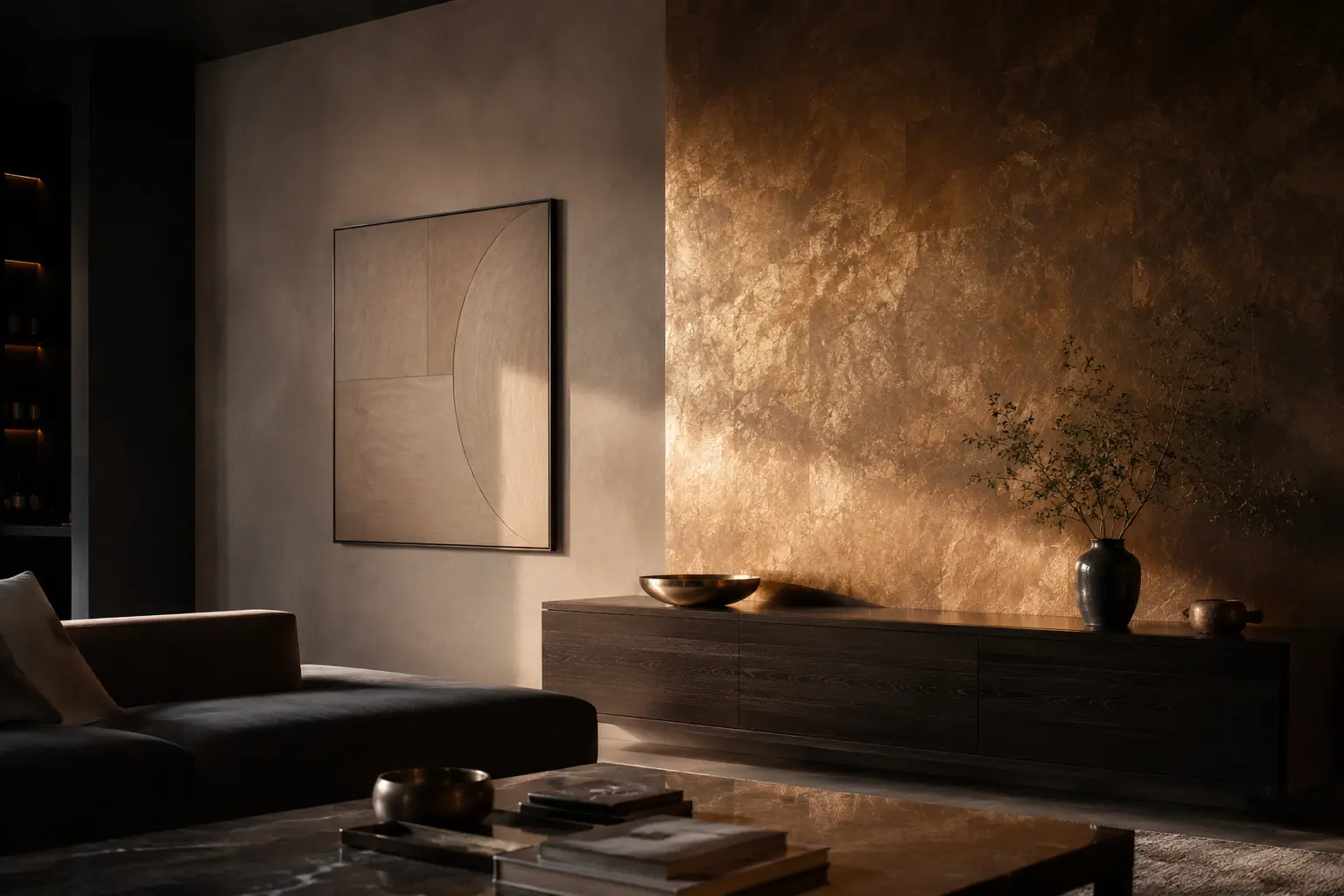
The single biggest decision in a decorative finish is often not the color at all. It is how the finish meets the light. That choice runs along one clear axis: matte mineral finishes that soften and absorb light at one end, and metallic or pearl finishes that catch and reflect it at the other. Almost everything else - color, texture, which room, which wall - follows from where you decide to sit on that scale.
It matters more in Orange County than most places, because the light here is generous and it moves. A wall that looks perfect at noon can read completely differently at dusk, and a finish chosen for how it behaves in the light will age far better than one chosen from a photo. Think of the finish less as a color on a wall and more as a way of shaping the light that already fills the room. This guide walks through both ends of the scale, how each behaves in a real room through the day, and how to decide which your walls want. To see the whole range first, start with our finishes overview.
It is a scale, not two boxes
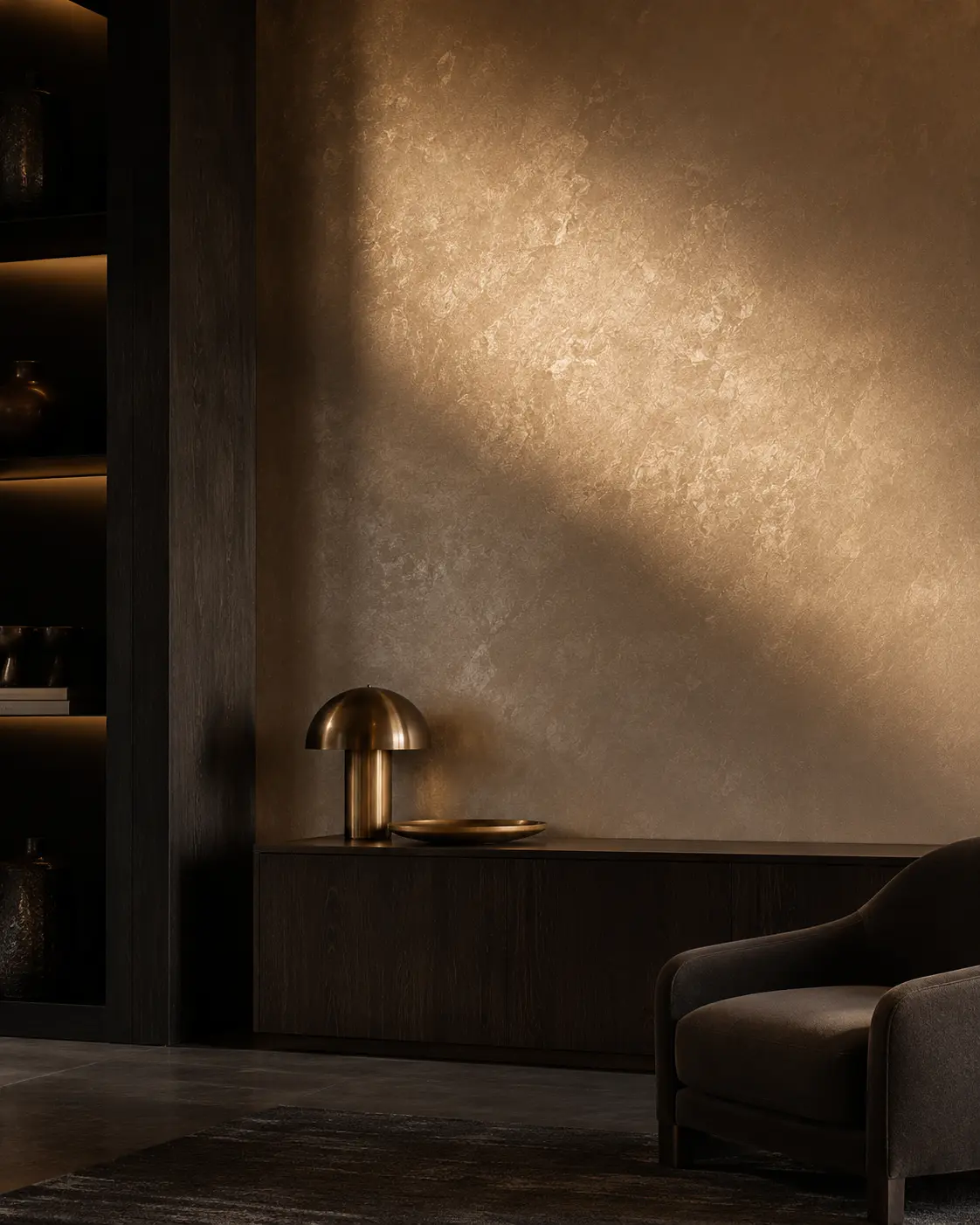
Matte and metallic are not two separate categories so much as the two ends of one dial. Most finishes sit somewhere along it: a chalky lime wash at the far matte end, a soft pearl in the middle, a bright metallic at the luminous end. Choosing a finish is really choosing where on that dial you want your wall to land.
Matte mineral finishes - calm and light-absorbing
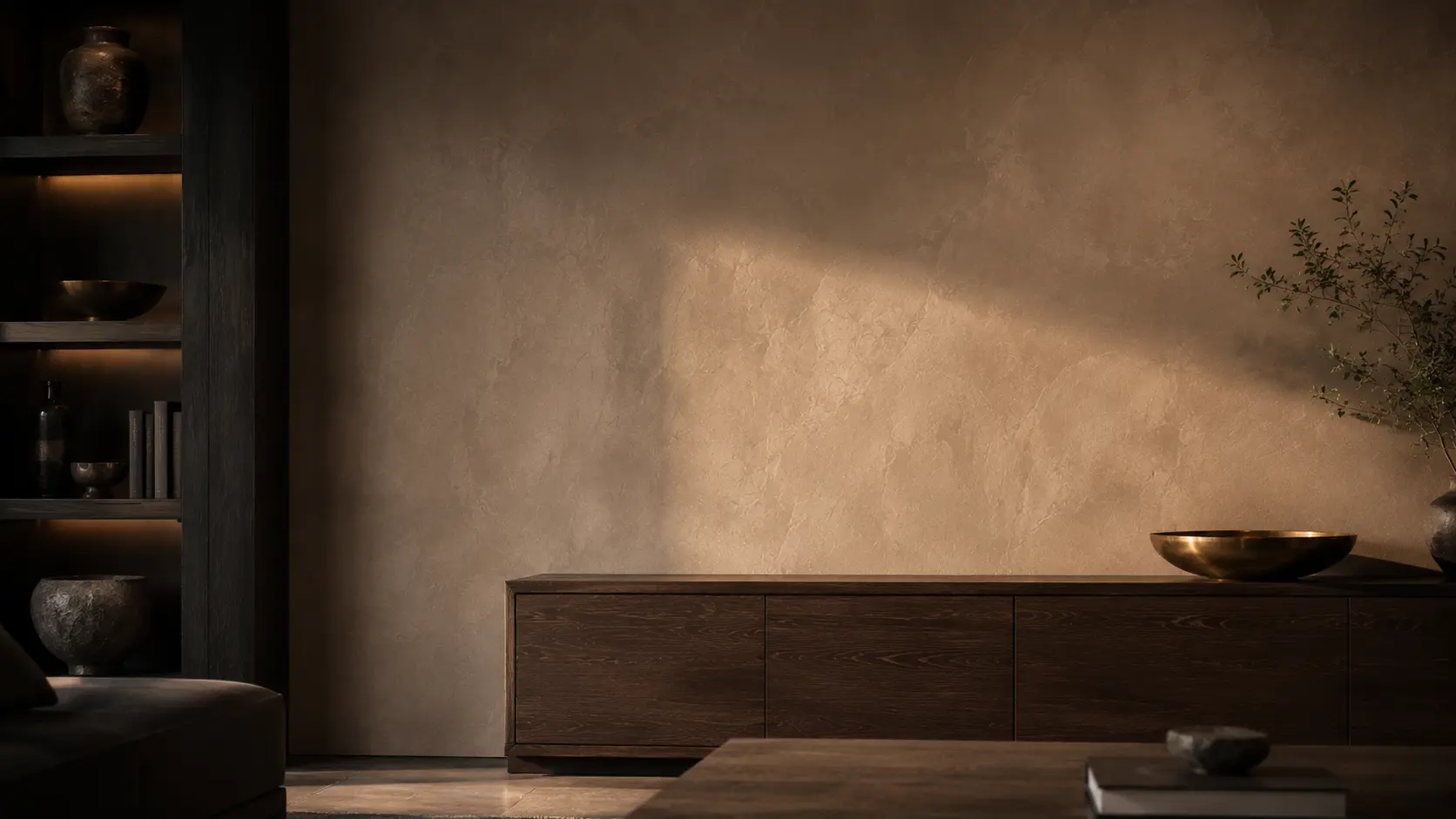
At the matte end sit finishes like lime wash and Roman clay. These diffuse light rather than return it. Instead of a highlight, you get a soft, even glow across the whole surface. They read as calm, grounded and clearly hand-worked, and crucially they let the rest of the room lead - the furniture, the art, the view - rather than competing with it.
In bright rooms this is a real advantage. A matte finish keeps a sun-filled space feeling soft rather than glaring, and it hides small imperfections and daily wear better than any reflective surface can. It is the finish you choose when you want the wall to be a quiet, beautiful background rather than the main event.
Metallic and pearl - luminous and reflective
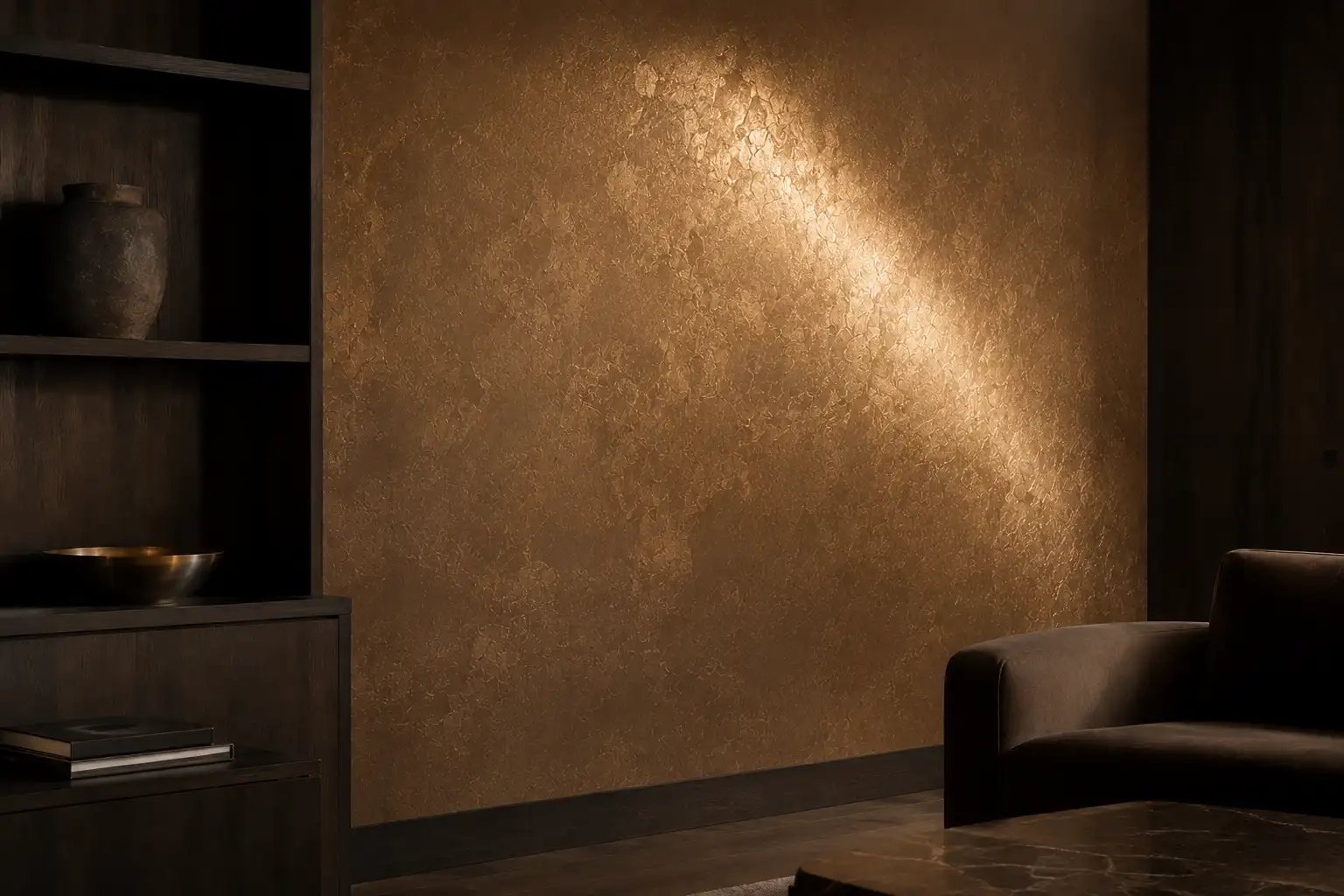
Metallic and pearl finishes - including Cadoro, Pearl Velvet and Velatura effects - do the opposite. They catch the light and shift as you move past them. A metallic wall is never quite the same twice: it changes with the time of day, with where you stand, with whether the lamps are on. That movement is exactly what gives it a sense of luxury and depth.
Because they are so active, these finishes work best as a focal point rather than as every wall in a room. One luminous wall behind a fireplace, a bar, or a bed becomes the thing your eye goes to. Spread across a whole room they can feel restless; used as a single accent they feel considered and rich. This is a finish chosen to make a wall perform, not recede.

Why metallic changes as you move
A metallic or pearl finish carries fine reflective particles suspended in the plaster. As the angle between you, the wall and the light source changes, different particles catch the light, so the surface appears to shift and travel. It is the same effect that makes silk or pearl fascinating up close, applied to a wall.
How they behave through the day
This is where the two finishes reveal how different they really are, and why seeing them in your own light matters so much. A matte wall stays broadly consistent from morning to evening - it softens the light at every hour, so the room keeps a steady, calm mood. It is predictable in the best sense.
A metallic wall is the opposite. In flat midday light it may look almost quiet; by late afternoon, when the sun rakes across it at a low angle, it can come alive and glow. Under warm lamplight in the evening it changes again. For some rooms that drama is the whole point; for others it is more than the space wants. Knowing how a wall will behave at the hours you actually use the room is the key decision, and it is one a photo simply cannot show you.
How to choose
The decision becomes simple when you start from what you want the wall to do, not from the material. A short way to think about it:
- Want the wall to recede and keep the room calm: choose matte.
- Want the wall to glow and become the focal point: choose metallic or pearl.
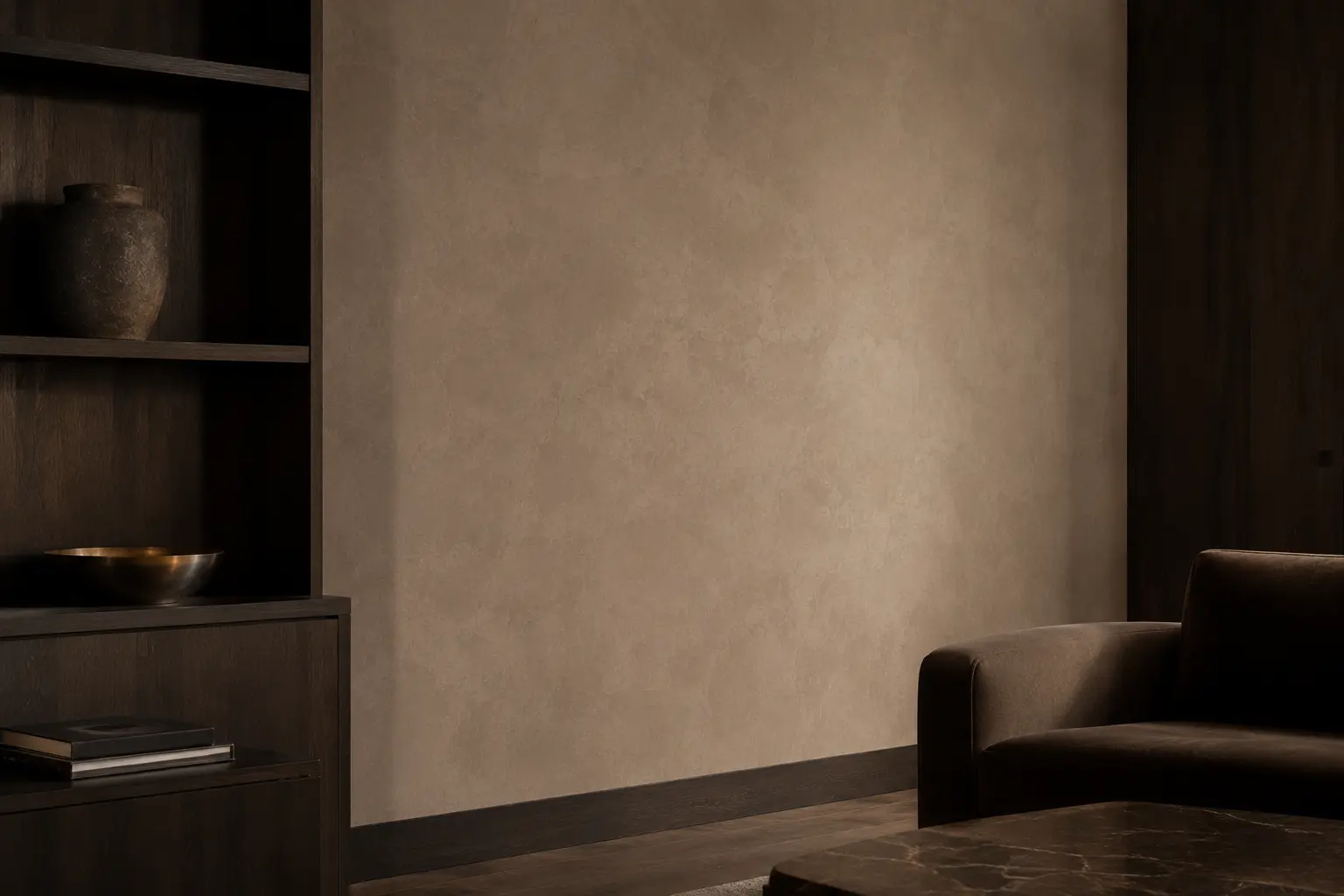
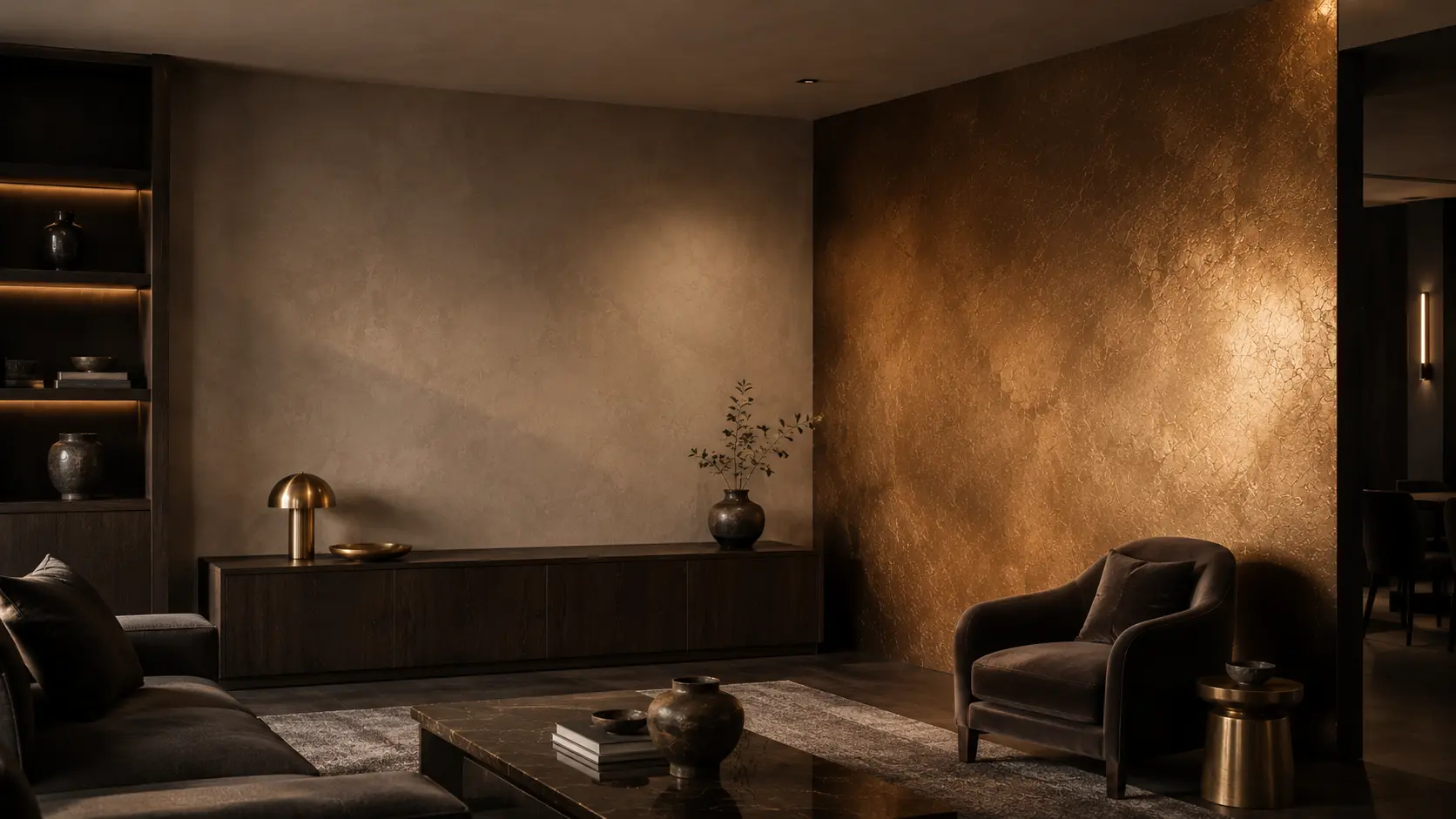
- Want both: use matte across the room and one luminous accent wall - the most reliable combination of all.
That last option is worth dwelling on, because it is how many of the best rooms are built. Matte on the main walls gives calm and lets the space breathe; a single metallic or pearl accent gives it a moment of performance and shine. The two are not rivals - used together, each does the job the other cannot, and the contrast between them is part of what makes the room feel designed. It is also the most flexible starting point: you can always add a second accent later, but a room built entirely in reflective finishes is far harder to calm down after the fact.
Matte lets a room breathe; metallic makes it perform. The trick is knowing which wall wants which.
SBK Group
Matching the finish to the room
Beyond the wall itself, the room decides a lot. Matte finishes suit the spaces you want to feel restful and grounded - bedrooms, living rooms, hallways, and any room already full of light where a reflective wall would only add glare. They give those rooms a soft, even calm that flatters everything in them without asking for attention.
Metallic and pearl finishes suit the rooms and moments where you want a lift. An entry that should make a first impression, a powder room where a little drama is welcome, a dining room that comes alive under evening light, a wall behind a bar or a bed. These are spaces used at particular times and often under warm artificial light, which is exactly when a luminous finish is at its most beautiful. The finish and the way the room is used should be chosen together, not separately.
Orange County homes, with their large windows and long hours of natural light, give you room to use both. A calm matte envelope through the main living spaces, punctuated by one or two luminous walls where the architecture already draws the eye, tends to give the richest result - the calm makes the shine feel special, and the shine makes the calm feel intentional.
Why the system still matters
As with any hand-applied finish, what you are choosing is a system, not a single coat - and that is as true at the metallic end as the matte one. A matte mineral finish is built up in hand-troweled layers over a prepared substrate and sealed for the room it lives in. A metallic or pearl finish adds reflective layers that have to be applied with control so the shift reads as intentional and even, not patchy.
This is why the same finish name can look ordinary or extraordinary depending on who applies it. The preparation underneath, the number of hand-applied coats, and the protection on top decide how the wall looks on day one and how it holds up for years. When you compare options, compare the finished system, not just the label.
Color reads differently on each
One thing people rarely expect is how much the finish changes the color itself. On a matte surface, a color reads true and even - what you choose is close to what you see, softened slightly and held steady across the wall. The finish stays out of the way and lets the pigment speak.
On a metallic or pearl surface, the same color becomes a range. The reflective layer means the hue shifts between its base tone and a brighter, lit version depending on the angle and the light, so a single warm neutral can travel from soft and shadowed to glowing and luminous across one wall. This is part of the appeal, but it also means a metallic color can never be judged from a flat swatch - it has to be seen moving, on a sample, in the room. It is the clearest example of why the two ends of the scale ask for different expectations.
Living with each finish
Day to day, both finishes are low-maintenance when they are built and sealed correctly, but they age a little differently. A matte mineral wall wears softly - small marks tend to blend into its already-varied surface, and it keeps its calm character for years with only gentle care. It is forgiving in busy, lived-in rooms.
A metallic or pearl wall rewards being treated as the feature it is. In its accent role, away from the highest-traffic touch points, it keeps its shift and glow beautifully. Placed thoughtfully - not on the wall everyone brushes past in a narrow hallway - it stays as striking as the day it was finished. In both cases, the right placement and the right protective system are what let the finish last, which comes back to planning the whole build for how the room is really used.
Common questions
Does metallic feel too much for a whole home
Used everywhere, yes, it usually does - the eye needs somewhere to rest. But as an accent it rarely overwhelms. The reliable approach is calm matte finishes through most of the home and one or two luminous walls where you want a lift: an entry, a powder room, a wall behind the bed. That way the metallic reads as a deliberate moment rather than a constant demand on the eye.
Is matte harder to keep clean
Not when it is sealed correctly for the room. A properly protected matte mineral finish wipes down and wears well; in fact its soft surface tends to hide fingerprints and small marks better than a reflective one, which can show them more readily. In both cases the sealing system is what tunes the finish for daily life.
Can the two finishes sit right next to each other
They can, and the contrast is often the point. A matte wall meeting a metallic accent at a corner gives a room both calm and shine in a single glance. The key is planning the transition so the two read as a considered pairing rather than an accident, which is part of what a finish specialist maps out before any work begins.
The takeaway
Matte and metallic are the two ends of one simple question: how much light do you want your walls to give back. Matte mineral finishes soften and absorb it, keeping a room calm and letting everything else lead. Metallic and pearl finishes catch and return it, turning a wall into a shifting, luminous focal point. Neither is better - they are different tools for different moods, and many rooms want both.
Decide what each wall should do, match the finish to your light, and confirm it the only reliable way there is: on a hand-applied sample, on your own wall, at the hours you actually live in the room. Do that, and the finish will look as considered years from now as it did the day it went on. A finish specialist can map which walls in your home want calm and which can carry a moment of shine, so the two work together rather than compete.
Try both in your room
We will bring hand-applied samples so you can see how each meets your light, then turn it into a written estimate.
See how each one meets your light
Tell us the room and the effect you want, and we will bring hand-applied samples and turn it into a written estimate.