
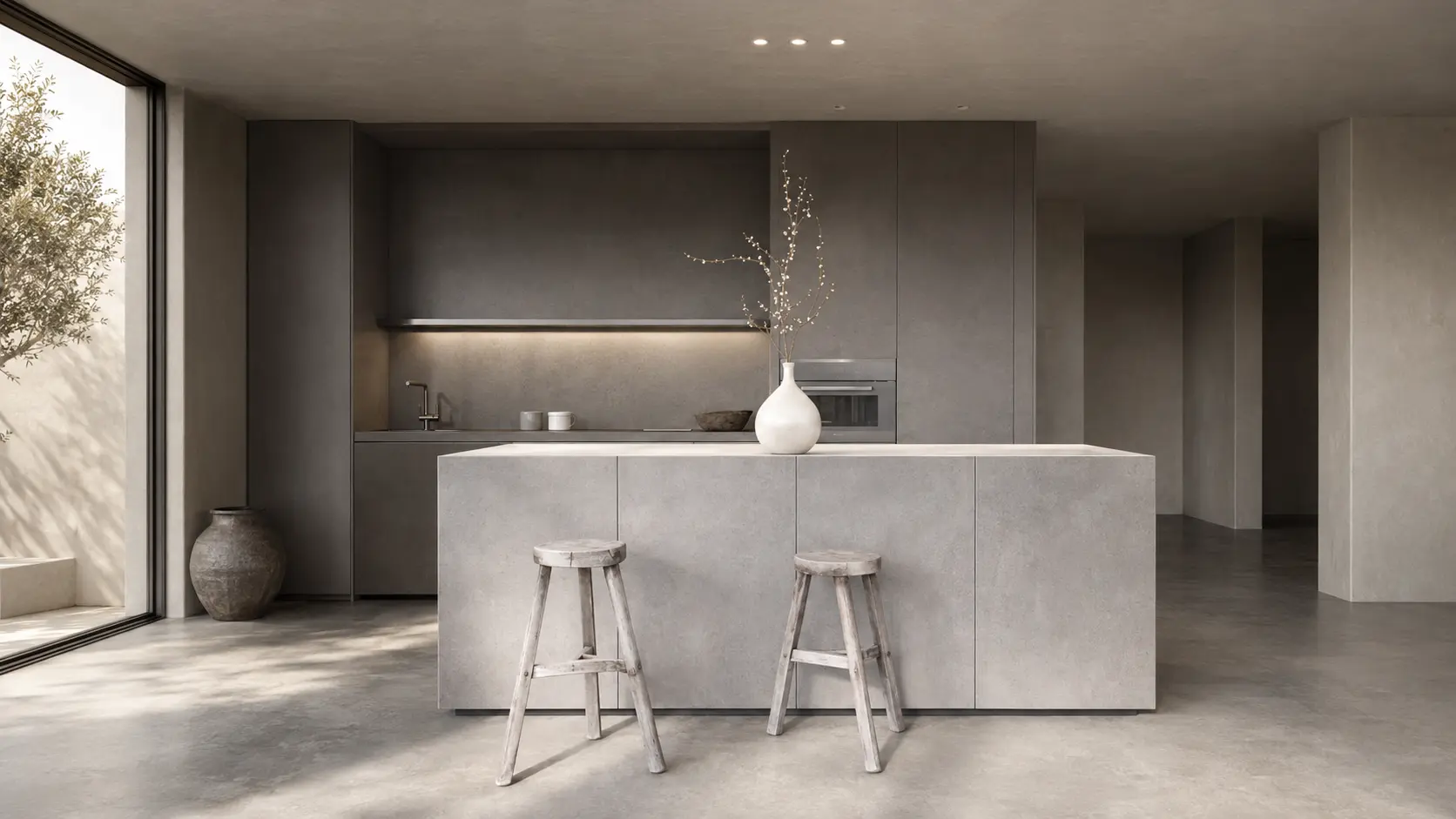
Concrete-Effect Plaster in Orange County - Polished Concrete, Without the Slab
The calm, architectural look of cast or polished concrete - the depth, the soft cloudiness, the honest mineral surface - built up by hand as a plaster, on the walls you already have. No poured slab, no structural weight, no demolition.
What Is a Concrete-Effect Finish?
A concrete-effect finish is a mineral plaster, built from cement and lime, that is troweled on in thin coats and then compacted and sealed to read as real concrete. It gives you the contemporary, quietly industrial surface people mean when they say "polished concrete" - the tonal movement, the matte-to-soft-sheen face, the sense of a solid material rather than a painted one - on ordinary wall substrates, inside or out. Because it is applied as a plaster and not poured, it works on walls that could never carry the weight of actual concrete, and it can be taken from a smooth polished face to a more textured, industrial surface depending on the room.
The Concrete-Effect Surface
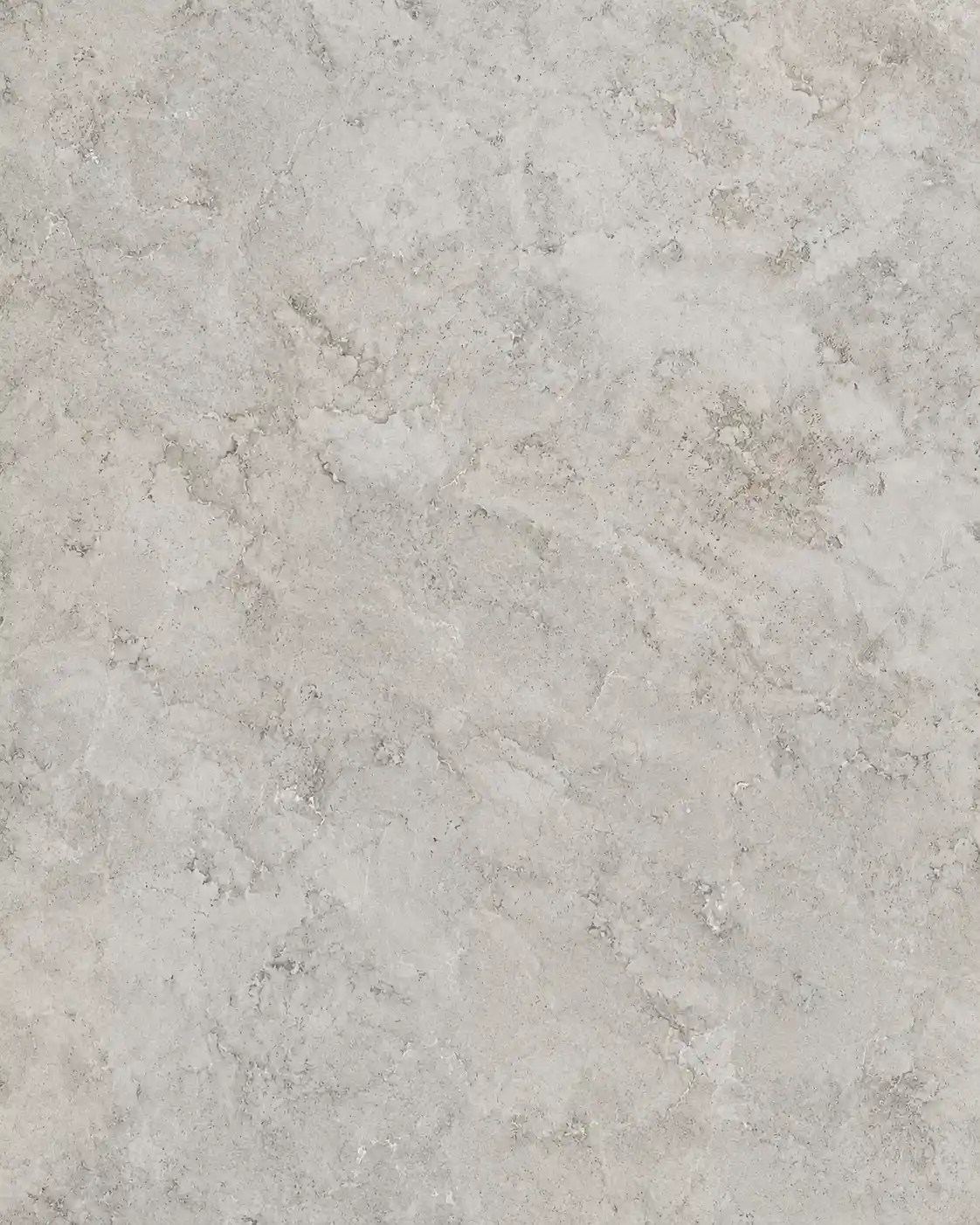
A closer look at the concrete-effect surface - the tonal depth and matte, mineral face of the material.

Concrete-Effect vs Microcement - What Is the Difference?
They are cousins, and they are often confused. Both are cement-based mineral finishes, both are applied by hand, both can give a seamless modern surface. The difference is body and intent. Microcement is a thin coating built for seamless, low-joint surfaces - the right answer for showers, wet floors and continuous wet-area work, because it bonds tightly, even over tile, and takes a waterproof seal. A concrete-effect plaster is applied in more substantial coats to build a genuine cast-concrete look, with more depth and tonal variation in the surface itself. If your priority is a seamless, water-tight wet room, that is microcement. If your priority is the honest, architectural face of concrete on a feature wall, a fireplace or an exterior, that is a concrete-effect finish. On a project where both matter, we use each where it belongs - and we will tell you which is which before any work starts.
Where Concrete-Effect Works - and Where It Doesn't
Works: living-room feature walls, fireplace surrounds, entry walls, media walls, and exterior facades and detail where a genuine concrete look is wanted without the slab. It holds a wide tonal range, from cool grey to warmer earth tones, and it sits well next to wood, stone, steel and glass.
Doesn't: it is not a wet-room finish. For a shower, a wet floor or a continuous water-exposed surface, the right answer is microcement, built as a waterproof system - not a concrete-effect plaster. It is also a finish that rewards restraint: it reads as intentional on a chosen wall or elevation, and can feel heavy wrapped around an entire room. We will say so if that is the direction a plan is heading.
Concrete-Effect Feature Walls, Fireplaces and Exteriors
On a feature wall, it gives a room a single calm anchor with real material depth. On a fireplace surround, it reads as a solid cast mass and pairs naturally with a raw or blackened firebox. On an exterior wall or facade detail, it brings the concrete look outside, where the same mineral system stands up to weather. Each of these is chosen and sampled for the specific light and setting before any full application.
How a Concrete-Effect Wall Is Built Up
- Substrate and priming: the surface is cleaned, made sound and primed. A concrete-effect finish is only as good as what it sits on, so preparation and the right primer come first.
- The coats and the compression: the plaster is applied in coats and then compressed and worked while it sets. Compression closes and smooths the surface and brings up the polished-concrete face; how far it is taken decides whether the wall reads smooth and refined or more textured and industrial.
- Sealing and protection: once cured, the surface is sealed with a penetrating sealer that protects it without changing its color or its matte character.
What a Concrete-Effect Finish Costs in Orange County
A concrete-effect finish is a project finish, priced for the specific wall rather than by a fixed per-square-foot rate - the figure depends on the wall size and access, the substrate condition, whether it is interior or exterior, and how much texture and polish the look calls for. Heavy prep, structural work and difficult access are quoted separately. The way to a real number is a site visit and a written estimate.
What your investment includes
Every concrete-effect finish is hand-applied and priced to the project, not by a fixed catalog rate. Your investment reflects the surface, the substrate, the level of preparation, the complexity of the space and the finish system itself - installed, with premium materials, surface preparation and sealing all included. We give you an exact, itemized figure after a free in-home consultation, where we sample the finish in your space and your light.
Maintenance and Durability
A sealed concrete-effect wall is low-maintenance: wipe it with a soft, damp cloth and a pH-neutral cleaner, avoid abrasive pads and harsh chemicals, and it holds its look for years. Like all mineral finishes it develops a quiet character over time rather than looking plastic and static. If a wall ever needs a refresh, the same system can be re-sealed or re-worked by hand - it does not have to be torn out.
Concrete-Effect FAQs
No. Both are cement-based hand-applied finishes, but microcement is a thin coating built for seamless wet areas, while a concrete-effect plaster is applied in more substantial coats to build a genuine cast-concrete look for feature walls, fireplaces and exteriors.
For a shower or a wet floor, the right finish is microcement, built as a waterproof system. A concrete-effect plaster is for feature walls, fireplaces and exteriors, not continuous wet exposure.
Yes. The same mineral system is suitable for exterior walls and facade detail, sealed for weather.
Applied over a properly prepared, stable substrate and sealed correctly, a lime-and-cement plaster resists cracking better than a pour, because the lime content adds flexibility. Preparation is what prevents cracking, which is why we do not shorten it.
On a hand-applied sample, in your room's own light. A concrete-effect surface shifts with the light and the setting, so we confirm the final color on a real applied sample on-site - never from a screen.
Ready to Explore a Concrete-Effect Finish?
Tell us about the wall or the space you have in mind. We will confirm whether a concrete-effect finish is the right call, or point you to the finish that fits better, and prepare a hand-applied sample before anything is committed.
An estimate is a conversation about fit, not a commitment - if a concrete-effect finish is not right for your wall, we will say so.