
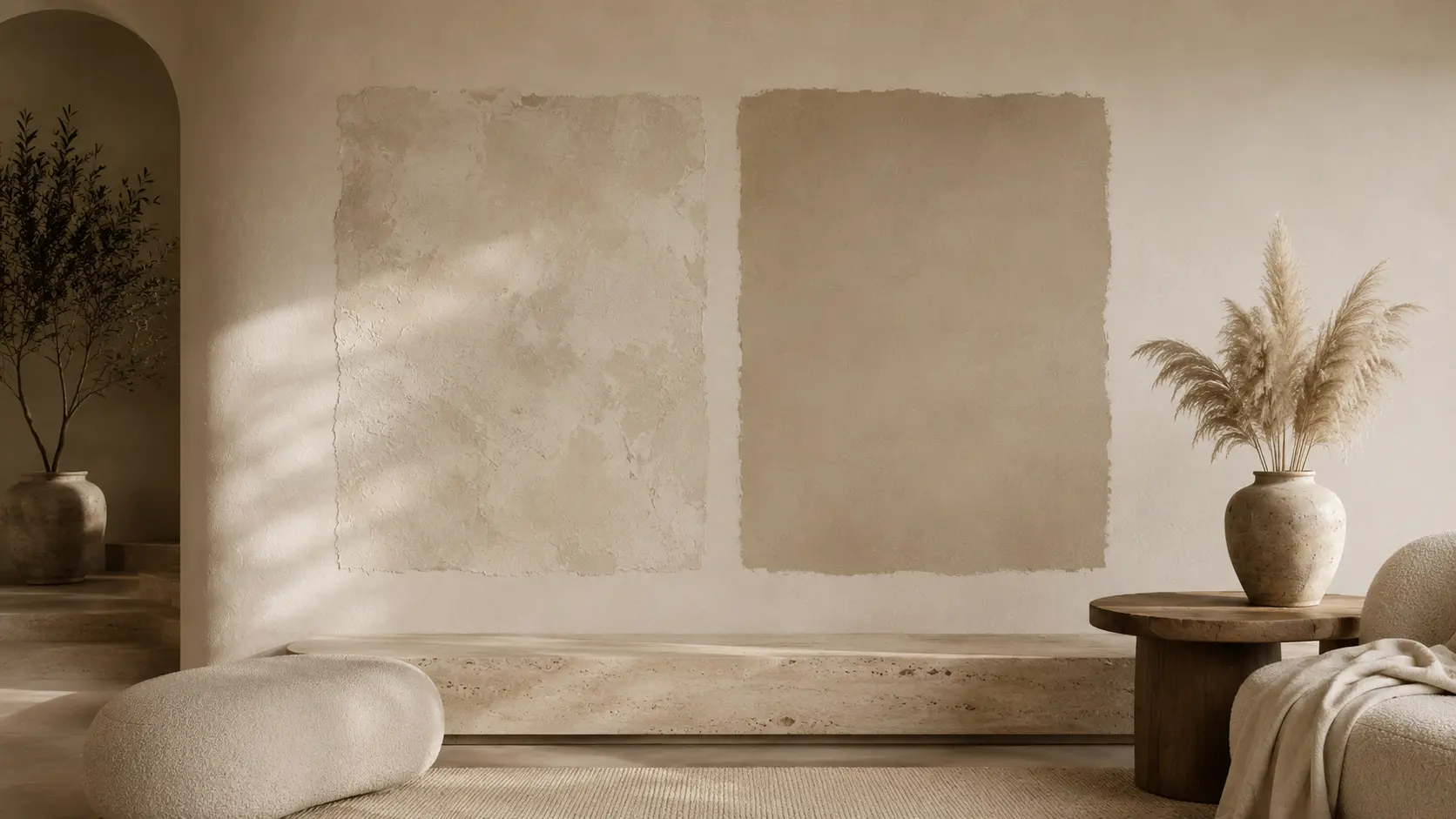
Lime Wash vs Roman Clay - Two Matte Mineral Finishes, Compared
From across a room they can look like cousins: soft, matte, mineral, calm. Up close they behave differently. Lime wash is alive - it moves, breathes and patinas like the natural material it is. Roman clay is velvety and even - a smooth, hand-troweled surface with warm, quiet depth. Here is how to choose between them for an Orange County home.
The Short Answer
If you want an organic, living wall with soft cloudy movement and a finish that ages and patinas over time, choose lime wash. If you want a smoother, more even, velvety matte surface with warm depth and a more composed look, choose Roman clay. Both are dry-wall interior finishes - neither belongs in a wet area - so the choice is about the look and the feel, not the room's plumbing.
How They Look
Lime wash has visible movement - soft clouds and tonal shifts across the wall, an organic, weathered, almost fresco-like quality that is never perfectly uniform. That variation is the point. Roman clay is more even and velvety - a smooth, suede-like matte with subtle depth rather than cloudiness, reading as calm and composed. If you love the idea of a wall that looks hand-made and a little imperfect, lime wash; if you want quiet, smooth, refined, Roman clay.
How They Feel and Age
This is the real difference. Lime wash is breathable and mineral, and it is meant to move and patina - it settles and softens over years, which is a feature, not a flaw. People who do not know that sometimes read the natural aging as a defect; people who do, choose it for exactly that life. Roman clay holds a more stable, even, velvety surface - it is the more predictable of the two, changing far less over time. Choose lime wash if you want a finish that lives and evolves; Roman clay if you want one that stays put.
Where Each One Fits
Both are for dry interior walls - living rooms, bedrooms, dining rooms, entries, feature walls. Lime wash suits organic, calm, characterful interiors - the kind of room that wants softness and a sense of age. Roman clay suits minimalist and contemporary interiors - rooms that want smooth, quiet, even surfaces. Neither belongs in a shower or a wet floor; for those, the answer is microcement, and we will point you there rather than put a matte clay finish somewhere it cannot survive.
Maintenance
Both are low-maintenance dry-wall finishes cleaned gently with a soft, dry or barely-damp cloth. The difference is in expectation: lime washis supposed to develop character over time, so "maintenance" is mostly accepting and enjoying how it ages, with occasional refreshing. Roman clay stays more uniform, so it simply holds its look with minimal attention. Neither is a high-upkeep finish; they just age on different terms - one evolves, one stays even.
What Each One Costs
Both are hand-applied mineral finishes priced per square foot, and the range depends on surface prep, coat count, wall size, ceiling height and access. Lime wash and Roman clay sit in a similar band as calm, matte interior finishes - the specific figure comes from the room, not from a chart. A site visit turns it into a written estimate.
Lime Wash vs Roman Clay FAQs
Movement. Lime wash has soft, cloudy, organic variation and patinas over time; Roman clay is a smoother, more even, velvety matte that stays more uniform. Both are matte mineral finishes, but one lives and evolves while the other stays composed.
No. Both are dry-interior-wall finishes and neither is built for continuous water exposure. For a shower or wet floor the right finish is microcement, applied as a waterproof system.
Both are low-maintenance. Roman clay stays more uniform with minimal attention; lime wash is meant to age and patina, so its "upkeep" is mostly enjoying how it changes, with occasional refreshing. Neither is high-effort.
Because it is supposed to. The soft, cloudy variation is the character of a real breathable lime finish - it is a feature, not a defect. If you want a perfectly even matte instead, Roman clay is the better fit.
On a hand-applied sample of each, on your own wall, in your room's light. Lime wash suits organic, characterful rooms; Roman clay suits smooth, minimalist ones. We confirm the look on-site before any full application.
So Which Should You Choose?
Ask what you want the wall to do over time. If you want it to live - to move, soften and patina into something with age and character - lime wash. If you want it to stay a smooth, even, velvety matte that reads calm and composed and changes little - Roman clay. Both are honest, beautiful dry-wall finishes; the right one is simply the one whose way of aging matches the room you want. We will show you both on a hand-applied sample before you decide.
An estimate is a conversation about fit, not a commitment - we will show you both finishes on your own wall before you choose.